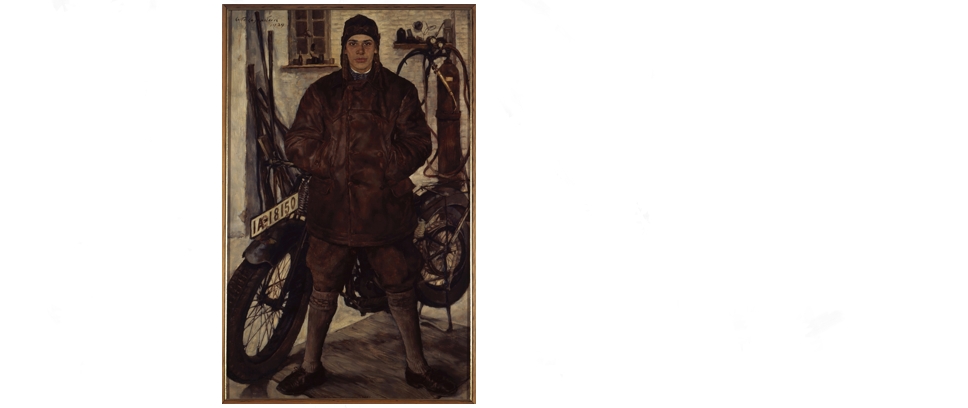
Man and Machine. Lotte Laserstein’s painting “On Motorcycle”
Julia Voss | 28 November 2025
In the exhibition “Nature and German History. Faith, Biology, Power” the DHM shows a very special work by Lotte Laserstein: the portrait of her cousin entitled On Motorcycle, painted in 1929.[1] Curator Julia Voss examines the relationship between “Man and Machine” in the 1920s as well as the life of the artist.
Kurt Lazaros, Laserstein’s cousin, stands with legs firmly planted in his workshop, hands buried in his leather jacket pockets, gazing out of the painting. In the background, Laserstein has assembled the tools needed to maintain a motorcycle. Oil cans, cables, a compressor to inflate the tyres. Everything seems ready to head off on the road. Moreover, the artist paints Lazaros and his motorcycle, an NSU 251 R, tone-in-tone. The motorcycle harmonises with Lazaros, man and machine merge into a modern centaur.

A special time had dawned for Laserstein. She was one of the first women to study at the Berlin Art Academy, where she graduated with honours in 1927. In the German Empire women had been denied access to the academy, but the Weimar Republic opened up completely new possibilities.
Laserstein came to realise her full potential. She created one surprising picture after another, depicting people and scenes that were new in art history. It had been claimed too quickly that everything had already been painted. The swan song for Objectivity had been sung too soon. Laserstein portrayed a female tennis player with a man’s haircut taking a break at the edge of the court, the afternoon sun casting dramatic shadows. She painted herself in her Berlin studio wearing a white coat, the metropolis in the background, her favourite model Traute Rose lying nude in the foreground. The portrait of her cousin with the motorcycle and his beautiful big eyes resembled the artist so closely that some people believed the painting to be a self-portrait.
Historically, this unusual depiction captures an important stage in industrialisation: motorisation entered private life. The image of nature changed as cars and motorbikes allowed modern excursionists to whizz past the countryside. And the self-image also changed. What was considered human nature had to be redefined as well.
“Man has, as it were, become a kind of prosthetic God. When he puts on all his auxiliary organs he is truly magnificent,” concluded Sigmund Freud, the Austrian physician and founder of psychoanalysis, in his famous essay Civilisation and its Discontents from 1930. “With every tool man is perfecting his own organs,” writes Freud. “Motor power places gigantic forces at his disposal, which, like his muscles, he can employ in any direction […]”[2]
According to Freud, technology and science had produced a number of “auxiliary organs”, from spectacles and microscopes to telephones, ships, aeroplanes, motor cars and motorcycles. These inventions enabled humans, who “first appeared as feeble organisms” in the course of evolution, to transcend themselves.
Freud was not familiar with Laserstein’s painting, yet his observations can be read as a commentary on her picture. Both witnessed the same developments of the technological age. In figures: from 1921 to 1931, the number of motorcycles in Germany increased from just under 26,700 to around 800,000. The number of automobiles also increased steadily. Between 1924 and 1932, the number of cars in the German Reich grew from around 132,000 to more than 497,000. Neckarsulmer Fahrzeugwerke AG (NSU) was the first German company to produce motorcycles on an assembly line. The NSU 251 R in Laserstein’s painting, built in 1927, was equipped with a 250 ccm engine. In Berlin, Germany’s first traffic light system was put into operation in 1924 on the bustling Potsdamer Platz.

Just one year later, the cautious optimism emanating from Laserstein’s On Motorcycle had disappeared. In 1930, she painted Abend über Potsdam (Evening over Potsdam), a large-scale group portrait and melancholy farewell to Berlin as a city of new beginnings and freedom.
For Laserstein, everything changed after 1933. As a Jew, she was expelled from the professional artists association and was soon banned from exhibiting her paintings. The National Socialists denounced her works as “degenerate”. Her painting Im Gasthaus (In the Inn) was confiscated from a Berlin museum.
When she was invited to exhibit at the Modern Art Museum in Stockholm in 1937, she left Germany and never returned. Laserstein tried in vain to bring her mother and sister to Sweden. Her mother Ida was murdered in the Ravensbrück concentration camp in 1943. Her sister Käte survived, traumatised, in a hiding place in Berlin and did not come to Sweden until 1946. What became of Kurt Lazaros is still unknown. Lotte Laserstein died in 1993 in the southern Swedish coastal town of Kalmar at the age of 94.
After 1945, German art history ignored Laserstein, believing her paintings to be worthless. When did this change in Germany? When the groundbreaking exhibition Lotte Laserstein. My Only Reality was shown in Berlin in 2003. The exhibition was made possible by the tireless research of the brilliant art historian Anna-Carola Krausse and the passionate commitment of the private Berlin association “DAS VERBORGENE MUSEUM” (The Hidden Museum), which was organised and run by women. The exhibition was a turning point.
Today, Lotte Laserstein is once again considered one of the most famous artists of the Weimar Republic.
[1] On Laserstein in general and the painting in particular, cf. Anna-Carola Krausse, Lotte Laserstein. Meine einzige Wirklichkeit, 2. aktualisierte Auflage, Berlin 2022, p. 91f.
[2] Sigmund Freud, Das Unbehagen in der Kultur und andere kulturtheoretische Schriften [1930], Frankfurt a. M. 2007, p. 56f. Quoted from “Civilisation and its Discontents”, p. 34ff, Freud_SE_Civ_and_Dis_complete.pdf
|
|
Julia VossProf. Dr. Julia Voss is the curator of the exhibition “Nature and German History” and a research associate at the Deutsches Historisches Museum. |