Women’s Voices in the Street: SPD speech records in the 1928 election campaign
Anna-Lena Almstedt | 5 March 2026
Thirteen printed pages from the late 1920s. At first glance, nothing special, but the headline “Sprechplatte” (speech record) catches the eye. There it reads: “Instructions on the reverse”, which turn out to be instructions for use. Use for what? For phonographic records with SPD election campaign speeches. DHM’s student assistant Anna-Lena Almstedt sheds light on how the SPD speech records brought the 1928 election campaign, and with it women’s voices, out onto the streets of the Weimar Republic.

Berlin, spring 1928. The sounds of engines, rattling trams, and the clatter of horses’ hooves on cobblestones. In between, street vendors and musicians perform on street corners, interrupted by car horns and bicycle bells. All these sounds – amplified by the echo of the narrow streets – created the typical soundscape of the big city. Amidst this hustle and bustle, the SPD improvised campaign events in the middle of everyday urban life with the help of so-called loudspeaker trucks.
A record is placed on the turntable, the needle positioned, and a voice rings out from the loudspeaker on the roof of the truck, accompanied by the typical hiss of shellac records, but clearly audible above the street noise. This was made possible by the invention of electronic recording and the tube magnifier in 1925. For the first time, voices could be recorded and amplified so that they were audible even outdoors.
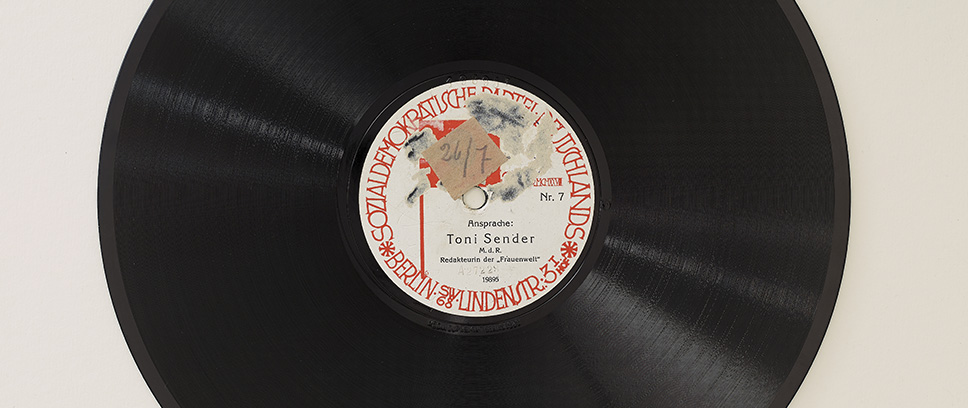
For the 1928 election campaign, the SPD produced a total of thirteen speech records with speeches by leading Social Democrats such as Philipp Scheidemann and SPD-affiliated figures such as Theodor Leipart, chairman of the General German Trade Union Federation. Each record combined a four-minute campaign speech with a well-known workers’ song, such as “Brüder, zur Sonne, zur Freiheit” (Brothers, to the Sun, to Freedom) or “Wann wir schreiten Seit’ an Seit’” (When We Walk Side by Side) on the reverse side. The music served as an acoustic earmark of the labour movement: catchy and mobilising. The songs reinforced the emotional impact of the speeches’ messages. [1]

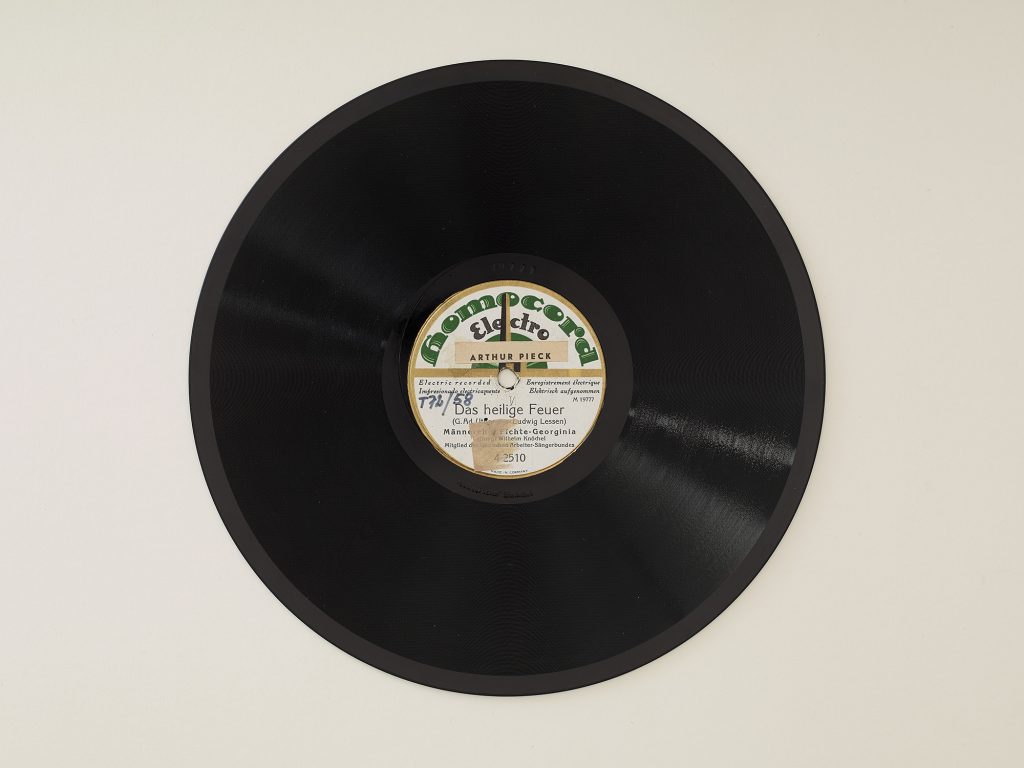
DHM, Inv.-Nr. T 72/58.1.
The accompanying text, now housed in the DHM collection, provides precise instructions for “faithful, vociferous and vivid reproduction” in front of large crowds and show that the records served as a modern campaign tool for addressing the masses. [2]
For the first time, in 1928, the SPD invested more in modern technology than in traditional campaign tools such as posters, signalling that it was the party of modernity and progress. [3] It had recognised that “the new era seems to require that the speaker seek out the voter.” [4] Instead of waiting for an audience, the SPD went out to the people. On the street, people could hardly escape the loudspeaker trucks. Added to this was their easy accessibility. The brief playing time forced the speeches to provide only the essentials. At the same time, it compensated for the lack of prominent speakers by duplicating and reinforcing the few well-known voices on the records.
Women’s voices – enhanced and unmistakable
Among the voices on the records were that of Toni Sender, member of parliament and editor of the magazine “Frauenwelt”, Marie Arning, member of parliament, and Marie Juchacz, chairwoman of the SPD Women’s Organisation and co-founder of the Workers’ Welfare Association. In their speeches they denounced the growing social inequality resulting from bourgeois economic policies and demanded that women be taken seriously as equal citizens.
The fact that their speeches were recorded on phonographic records is remarkable. Women had only been allowed to vote and stand for election since 1918. Women’s voices continued to be marginalised in public, and their political participation was still contested. Now, loudspeaker trucks literally carried women’s voices “onto the streets”. Their acoustic presence alone was a political act. Women claimed the public space that had been denied to them for centuries. Moreover, like male speakers, they expressed their political opinions and demanded equal political participation. [5]
From the street straight into the pocket
The 1928 election campaign marked a twofold turning point: the SPD tapped into new communication channels with phonograph records and loudspeaker trucks, giving women a voice as political actors and target groups. The parallels with today are striking.
In 1928, loudspeaker trucks brought the election campaign right up to people’s doorsteps. Today, political content in 60-second formats can reach us as we scroll through social media. Then as now, the aim is to bring political messages into voters’ everyday lives in a way that is short, concise, and as unavoidable as possible.
Workers’ songs have also found their digital counterpart in audio clips on TikTok and Instagram – catchy, recognisable, and emotional. But unlike the identity-building workers’ songs, today’s sounds are short-lived trends that politicians use specifically for algorithmic outreach. However, the basic principle remains the same: sound emotionalises politics and generates attention.
The most striking parallel, however, can be seen in the women’s voices. In 1928, records created an acoustic presence. They made women audible in the public space. Almost 100 years later, especially on International Women’s Day 2026, female politicians are present in public, including on social media. But even today, women who engage in public politics are still subject to sexist attacks. Technology has changed, but discrimination remains. And yet, today as then, presence is crucial. Every voice shifts the boundaries of what is taken for granted. Of course, visibility does not automatically mean equality, but the fight for equality is waged in the public sphere, then as now – whether on the street or on the smartphone.
[1] Hanns-Werner Heister, „Vorwärts und nicht vergessen. Politische Kampflieder” in Sounds des Jahrhunderts (Sounds of the Century), ed. Gerhard Paul and Ralph Schock (Bonn: Federal Agency for Civic Education, 2013), p. 166 f.
[2] 13 pages accompanying the SPD speech records, Berlin 1928, Inv. No. Do2 96/1575-87
[3] Dirk Lau, Wahlkämpfe der Weimarer Republik, Tectum Wissenschaftsverlag, 2018, p. 152 f.
[4] Vorwärts 188/20.4.: „Die Technik im Dienste des Wahlkampfes“, quoted in Dirk Lau, Wahlkämpfe der Weimarer Republik, p. 322.
[5] Karin Martensen, „70 Gender“, in Handbuch Sound. Geschichte – Begriffe – Ansätze, ed. Daniel Morat and Hansjakob Ziemer (Stuttgart: J.B. Metzler, 2018), p. 377.
|
|
Anna-Lena AlmstedtAnna-Lena Almstedt is a student assistant in the Special Exhibitions and Projects department of the Deutsches Historisches Museum. |