The Clothes Moth
25 May 2026 Reading duration 3 Min.
Part 1 of our series on pest control at the DHM began with an examination of integrated pest management. In Part 2, we focus on the clothes moth.
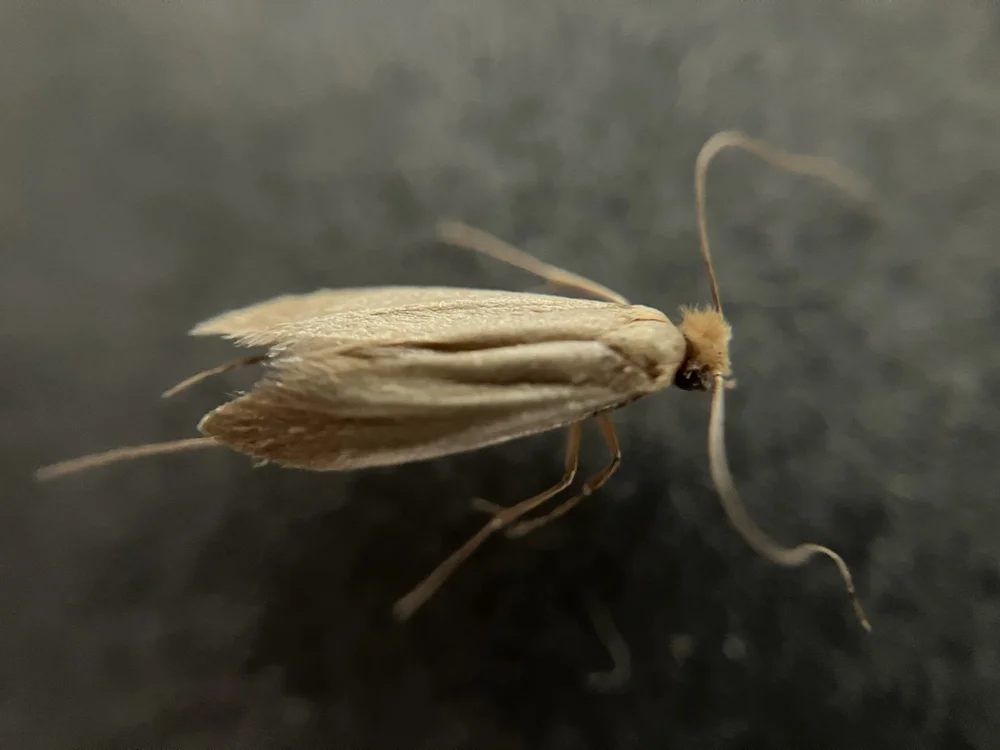
Clothes moth (Tineola bisselliella), maximum lifespan - barely more than two weeks, photo: Hannah Neumann
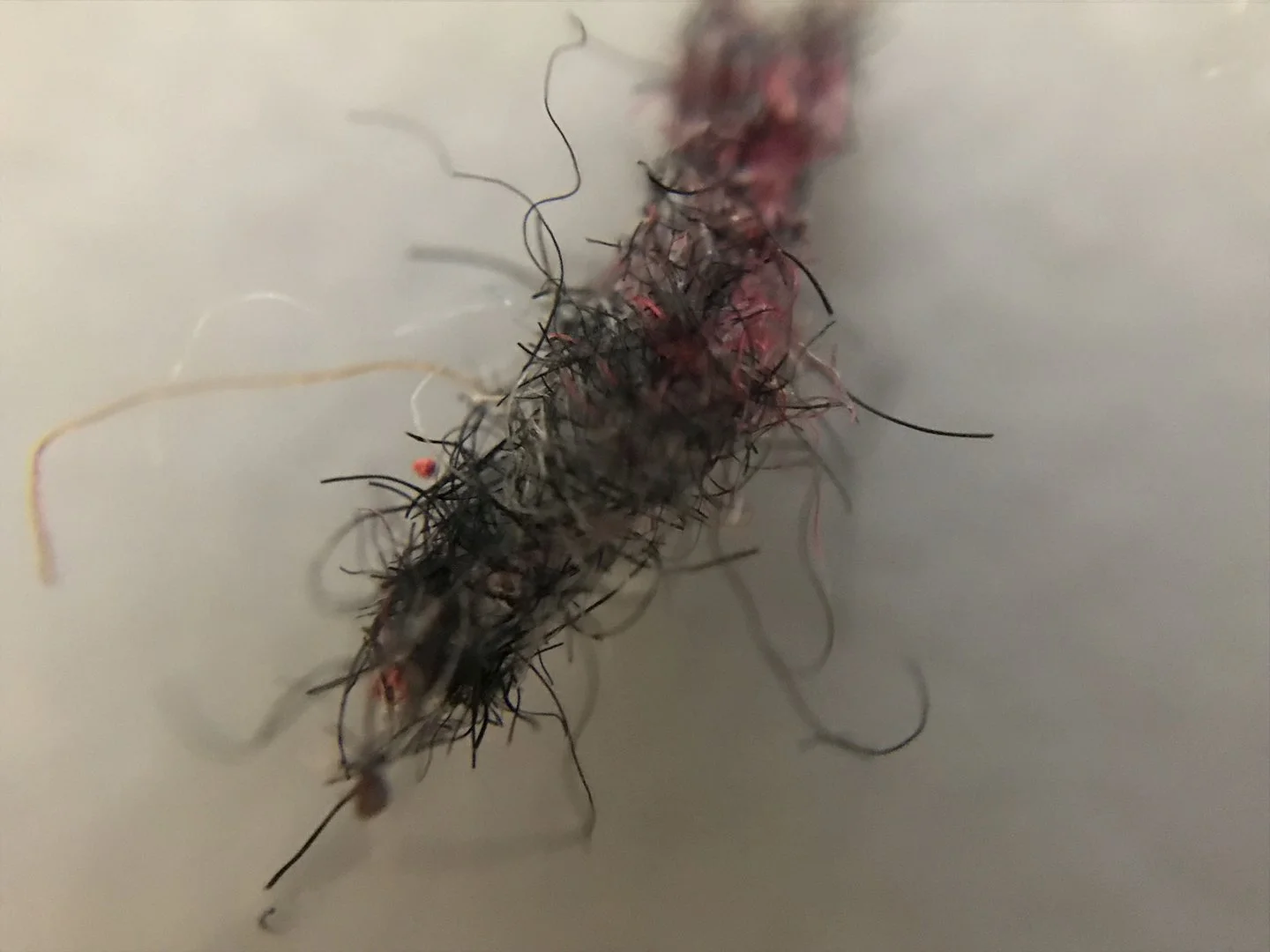
Silken tube of the clothes moth, photo: Hannah Neumann
The clothes moth (Tineola bisselliella) is an unusual moth. Unlike other moth species, which are attracted to light, it is highly photophobic and immediately seeks cover when disturbed. It grows to up to 7 mm in length and, depending on what the larvae feed on, has wings ranging from straw-coloured to golden yellow, without spots or markings. This sets it apart clearly from other moth species. In warmer temperatures, the males can fly up to several hundred metres. Their distinctively erratic, fluttering flight makes them easy to distinguish from their relatives, the food moths; at lower temperatures, however, they are less active. Females, by contrast, are fast runners and generally prefer to remain on the ground, taking flight only after laying their eggs.
Females live for just over two weeks. After mating, they lay up to 250 eggs, depositing them singly or in small groups on a suitable food source. After about two weeks, whitish, translucent larvae hatch. These larvae are the true pests, as adult moths have reduced mouthparts and do not feed.
Immediately after hatching, the larvae begin to build protective silken tubes, using threads produced by their spinning glands along with material from their surroundings and their own excrement. Open at both ends, these tubes protect them from drying out and from being eaten by predators, and the larvae rarely leave them. They feed primarily on keratin, a protein found in wool, silk, feathers, and hair. As a result, they may infest not only textiles and furs, but also carpets and upholstered furniture with horsehair filling. Even accumulations of dust – for example beneath display cases or in ventilation grilles – may be enough to sustain them. Viewed under a microscope, dust can be seen to consist partly of hair, skin flakes, and wool fibres, in other words, the animal protein essential to larval development.
In their search for suitable food sources, the larvae are guided by olfactory cues emitted by keratin-containing materials. They are also attracted to odours from sweat, skin flakes, and dirt.
Damage from clothes moths can be seen clearly in the form of small irregular holes scattered across the fabric, which distinguishes it from damage caused by other textile pests. In furs and skins, the larvae feed at the base of the hair, leaving bare patches. They cannot digest artificial silk and synthetic fabrics, but they can still chew through them.
After three to six weeks, depending on the temperature and food supply, and after the larva has moulted several times, the feeding phase is complete. The caterpillar then spins a thick-walled cocoon, closed at both ends, where it metamorphoses into a moth. After a further two to four weeks, the clothes moth emerges. The sexual pheromone released by the female immediately attracts males. Shortly after mating, the female lays her eggs in concealed places directly on a suitable food source, and the cycle begins anew.
Under favourable (warm and dry) conditions, the moth can develop from egg to adult in around 60 days, allowing for up to four life cycles in a single year. At lower temperatures, the larvae may stop feeding for extended periods, which slows their development. As soon as it becomes warmer again, they resume feeding.
Clothes moths can be detected using pheromone traps, which imitate the female sex pheromone, attracting males that are ready to mate and trapping them on an adhesive surface. This allows infestations to be detected early.
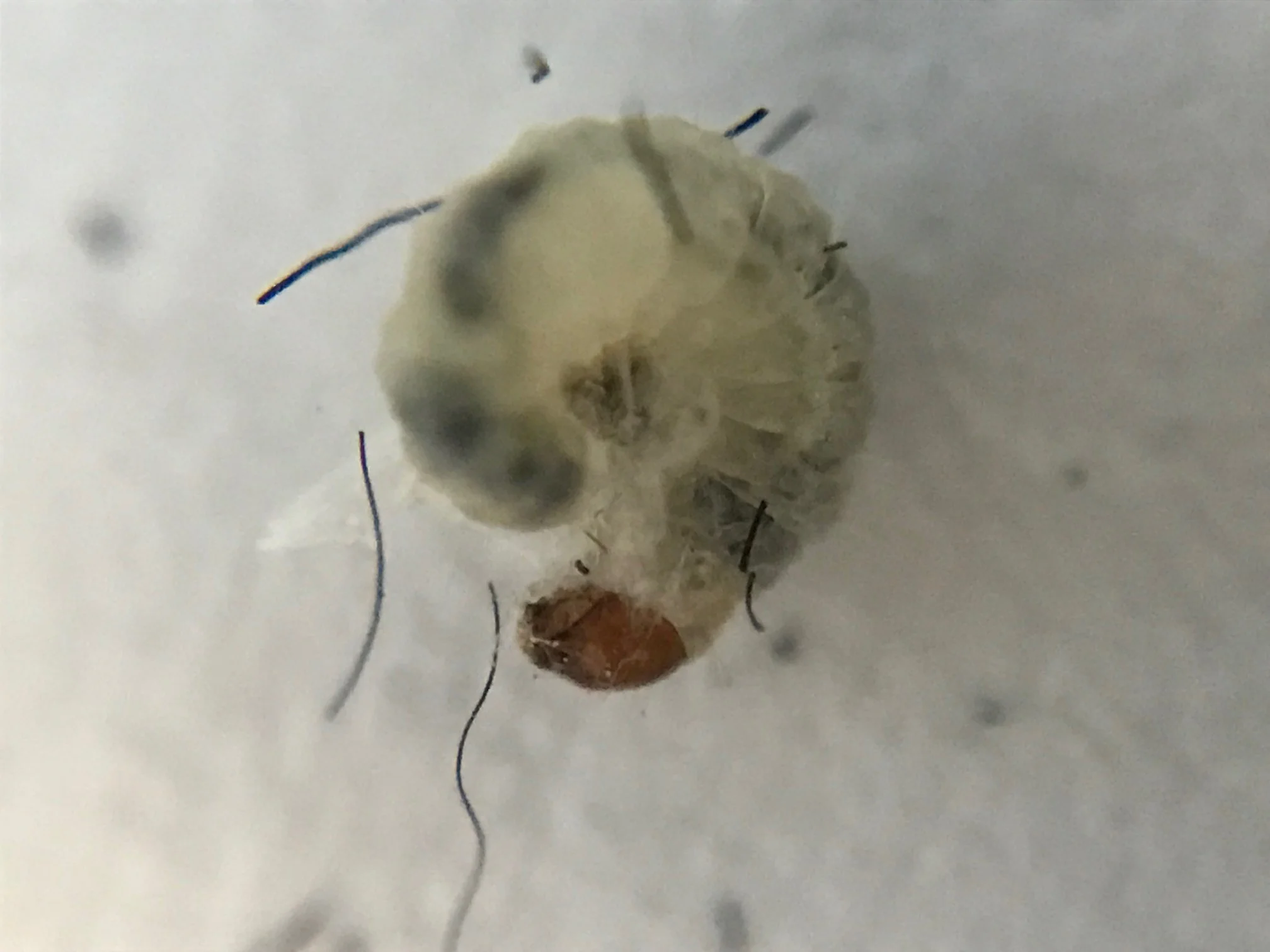
Larva of a clothes moth with black wool fibres inside its body, photo: Hannah Neumann
The Author

Hannah Neumann
Hannah Neumann is responsible for integrated pest management (IPM) and preventive conservation at the DHM.