
Lunar Landscapes and Lignite: The story of a bucket-chain excavator
9 June 2026
Martin BaumertNature and German History
9 June 2026 Reading duration 8 Min.
The temporary exhibition “Nature and German History: Faith – Biology – Power” features a 1:20 scale model of an ERs 700 bucket-chain excavator. Martin Baumert, the exhibition’s research associate, explains what an excavator has to do with the theme of nature and what significance lignite (brown coal) mining and land reclamation had for the GDR.
Probably no other country on earth has ever been as dependent on a single fossil fuel as the GDR was on its domestic lignite. In the 1980s, this raw material provided more than 80 percent of the country’s primary energy. In 1987, 310.89 million tons of raw brown coal were extracted, accounting for 29 percent of global production. Resource extraction took place largely in fully mechanised, large-scale, opencast mines, which devastated between 1,100 (1951) and 3,700 hectares (1986/88) of land annually. To extract the coal, the GDR required mining equipment, which it manufactured itself, primarily in Köthen, Lauchhammer, Leipzig, Magdeburg and Zeitz.
Bucket-chain excavators are a type of conveying machine; strictly speaking, they are trough-chain conveyors, a subcategory of continuous conveyors, since the conveying process can run without interruption. To this day, they are used in numerous kinds of opencast mining (surface mining), such as gravel pits, but also in ore mining, because they provide a significantly higher degree of mechanisation and thus greater cost-effectiveness than in underground mining. This is the main reason why Germany ceased hard coal production as early as 2018, but is not expected to phase out lignite mining until 2038.
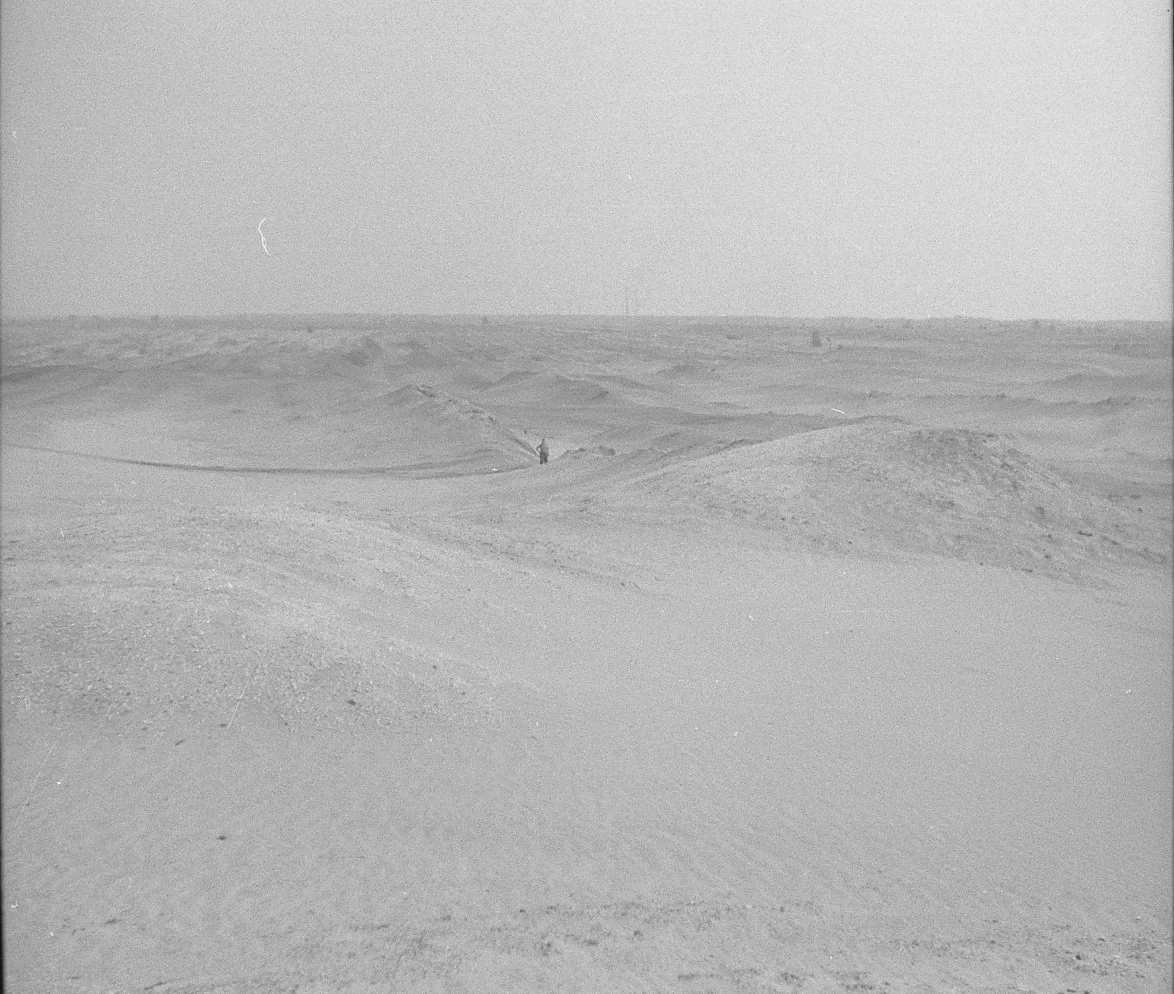
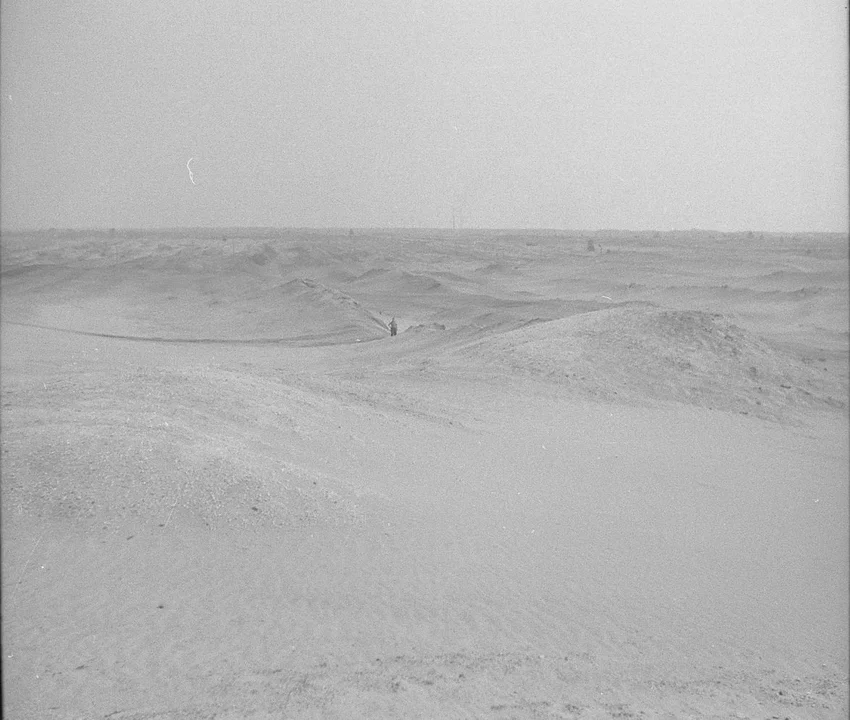
Lignite mining spoil tip, photo: Wilhelm Knabe (1923–2021), Koyne, Lusatia, 1957, reproduction, Berlin © the Knabe family
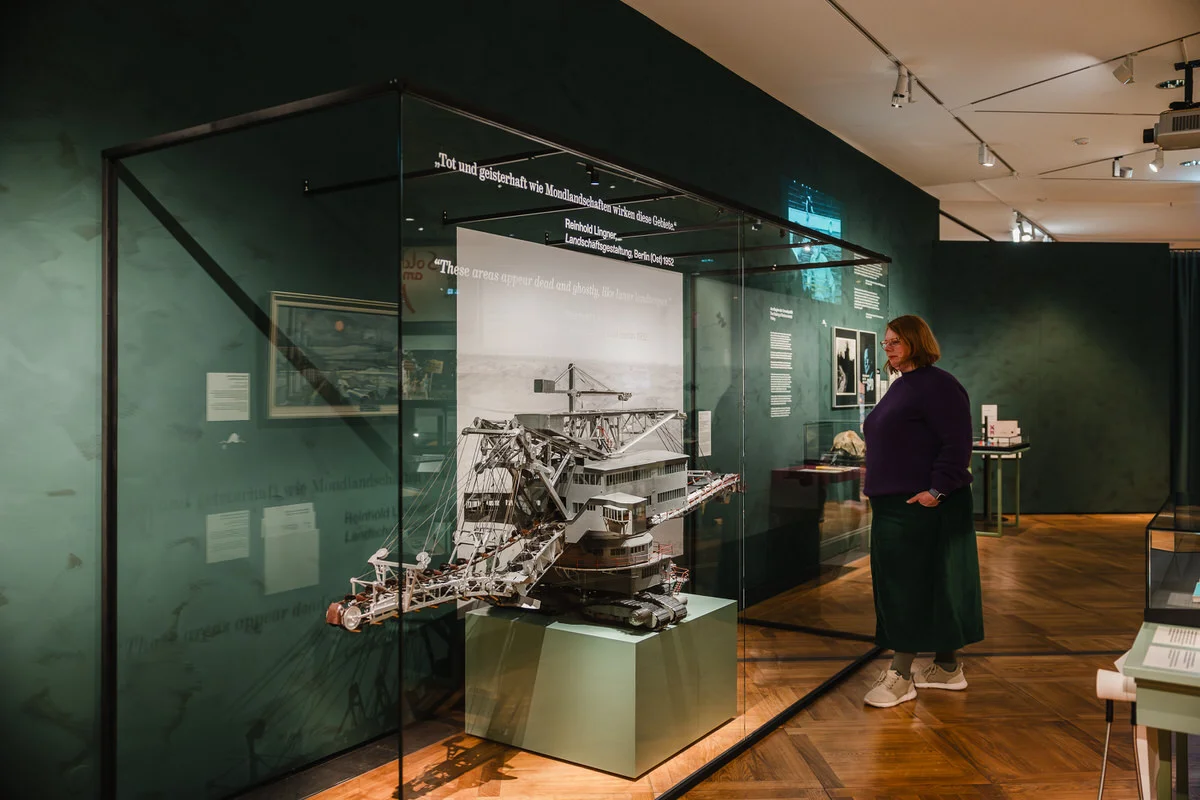
Model of the bucket-chain excavator in the "Nature and German History" exhibition © DHM/Sandra Kühnapfel
The exhibition “Nature and German History” features a 1:20 scale model of an ERs 700 bucket-chain excavator. Here, it symbolises the lunar landscapes it leaves behind in opencast mining operations, which are contrasted with the restoration of the landscape through the process of recultivation. The cryptic abbreviation and the number provide a precise description of the full German name of the machine: Eimerketten-Raupen-Schwenkbaggers ERs 700 (bucket-chain crawler excavator ERs 700): E-type bucket-chain excavator R-tracked (Raupen / crawler), s swivelling (schwenkbar) with a bucket capacity of 700 litres. It was manufactured by the State-Owned Enterprise (VEB) “Georgi Dimitroff”, a heavy machinery works in Magdeburg. These machines were produced from 1950 to 1956, before being replaced by the more powerful ERs 710 model. Strictly speaking, this was merely the model designation; when in service, each machine was assigned a unique registration number. Bucket-chain excavators with crawler tracks were given numbers between 151 and 350. The correct designation of the first machine, which was deployed at the Espenhain opencast mine from 1950 on, was “Bagger (excavator) 250 ERs 700”. The machine was relatively small, weighing approximately 1,000 tons. With its 35 buckets, the ERs 700 could theoretically move 1,300 cubic metres of material (waste or coal) per hour. Loose rock or coal could be excavated in both high-cut and low-cut operations. To do this, the bucket ladder was raised or lowered. Since its small size made it versatile for use in opencast mining, it made sense to design it with a swivelling mechanism. Rigid excavators are often more powerful, but are also restricted to use with a conveyor bridge. The maximum speed of the ERs 700 was 5.5 metres per minute. The largest bucket-chain excavators also came from Magdeburg. The Es 3750 not only had more than five times the bucket capacity (theoretical conveying capacity of 5,708 m³/h) but, weighing over 4,800 tons, was also almost five times as heavy. This type of excavator was also the largest ever manufactured in Magdeburg. It is used in conjunction with the largest mobile machines on earth, the F60 unit conveyor bridges in the Lausitz lignite mining area. One example of the F60 is on display at a museum in Lichterfelde near Finsterwalde – unfortunately without an accompanying Es 3750. Bucket-chain excavators are, incidentally, surpassed by bucket-wheel excavators. The largest of its kind, an SRs 8000 manufactured by TAKRAF GmbH, weighs over 14,196 tons, reaches a height of 96 metres, and can theoretically handle 10,000 m³/h of waste.
Bucket-chain excavators represented a significant technical advance for the mining and mechanical engineering industries. They originated in the Netherlands, where, from the 17th century on, floating or wet excavators with bucket chains were used in the development of waterways. The first patent for a bucket-chain dredger was granted to the Frenchman Poirot de Valcourt, who applied for a patent for such a machine in 1827. However, these machines first achieved their breakthrough during the construction of the Suez Canal, where dredgers designed by the Frenchman Alphonse Couvreux took the place of numerous workers and thus proved their practical suitability. In Germany, however, the term “Dutch dredger” became established towards the end of the 19th century, as two of the first such machines used in lignite mining were replicas of the Couvreux dredger produced by the Dutch firm A. F. Smulders. After being employed in canal construction – particularly the Trave canal excavated near Lübeck from 1878 on as well as the expansion of the Kaiser Wilhelm Canal between 1887 and 1895 – bucket-chain excavators were put to use in lignite mining from the 1890s on, thereby increasing the industry’s efficiency.
There are two reasons: first of all, Magdeburg is situated not far from the Central German lignite mining area and thus close to potential buyers; secondly, Magdeburg had a long tradition of mechanical engineering, particularly in the Buckau district, south of the old town. As early as the Industrial Revolution, major companies such as Grusonwerk began establishing themselves there in 1855. This was followed in 1862 by the machine works Maschinenfabrik Buckau R. Wolf AG. In 1886, the company began manufacturing equipment for briquette factories, which turned raw lignite into a sought-after fuel for domestic heating. Under the new director, Reinhold Lange, the company specialised in production for the lignite industry. It is not known exactly when the first bucket-chain excavator left the factory; however, those manufactured after 1908 were the first to feature a double-track design, which significantly increased their operational efficiency. In 1930, the Otto Gruson Works was taken over (not to be confused with the more famous Gruson Works, which was named after Hermann Gruson). In the Soviet Occupation Zone, the company – which had also been involved in the Nazi armaments programme – was expropriated and, as the Soviet joint-stock company (SAG) AMO, became part of the reparations regime. Following the failed popular uprising on 17 June 1953, the company was transferred to the GDR on 1 January 1954 and subsequently operated under the name VEB Schwermaschinenbau “Georgi Dimitroff”. In 1950, the ERs 700 was designed as the GDR’s first in-house excavator, constructed to meet the needs of the expanding opencast mining industry. As a relatively small excavator, it was primarily used in coal mining. For example, 250 ERs 700 excavator extracted the very last coal from the Espenhain opencast mine on 27 June 1996, before being scrapped in 1998. Production of the ERs 700 continued until 1956, but only a small number – less than ten – were produced, both for the GDR and for export within the Council for Mutual Economic Assistance (CMEA). By contrast, its improved successor, the ERs 710, was a resounding success with over 100 units produced, which were and continue to be used within the CMEA and its successor states. Such machines are still in operation today in the Lausitz, for example at the Welzow, Nochten and Jänschwalde opencast mines. No ERs 700 is still active, at least not in Germany. With the structural upheaval that followed the reunification, numerous opencast mines in East Germany were decommissioned. The modern machines were often transferred to other opencast mines, while older machines were blown up and disposed of. Bucket-chain excavators can still be viewed in Ferropolis – the “City of Iron” near Gräfenhainichen (Wittenberg district). On display there are an excavator 197 ERs 400, manufactured in Magdeburg in 1941, and an excavator 651 Es 1120, produced in Köthen in 1962.
The DHM model was most likely built by apprentices as a graduation project to demonstrate the excavator at trade fairs. Thanks to its several motors and a control panel, it is fully functional. To prevent the numerous motors – each of the six tracks, for example, has its own small electric motor – from operating in different directions, their controls were linked together on the control panel. The control panel itself is cube-shaped with a ca. 50 cm edge length. Two small figurines were even placed inside the control stations. The presentation of opencast mining technology at trade fairs was aimed primarily at exporters rather than at domestic customers. The machines for the domestic lignite industry was procured centrally within the framework of the planned economy, according to state priorities. The mining operators had little influence on the selection process. Overall, the GDR became a world leader in excavator manufacturing under the umbrella of the VEB Schwermaschinenbaukombinat TAKRAF (the acronym stands for Tagebau-Ausrüstung, Krane and Förderanlagen – opencast equipment, cranes and conveyors). In the process, the GDR became the world’s leading exporter of opencast mining equipment. Today, TAKRAF GmbH still manufactures machines in Lauchhammer and Leipzig. Maschinenfabrik Magdeburg-Buckau GmbH, however, did not survive the structural upheaval and was liquidated on 1 January 1995, before finally being struck off the commercial register on 16 August 1996. This brought to an end, after 130 years, to the history of the long-established site in Magdeburg, of which around 90 years were spent manufacturing large-scale opencast mining equipment. However, Förderanlagen Magdeburg (FAM), a company that manufactures conveyor systems for the mining industry, continues to operate to this day. The model of the ER 700, however, had already found its way into the East German Museum für Deutsche Geschichte (MfDG) while the company was still in the GDR. Following the transfer of the GDR museum to the DHM after 1990, the excavator found its way into our collection and thus into the exhibition “Nature and German History”.
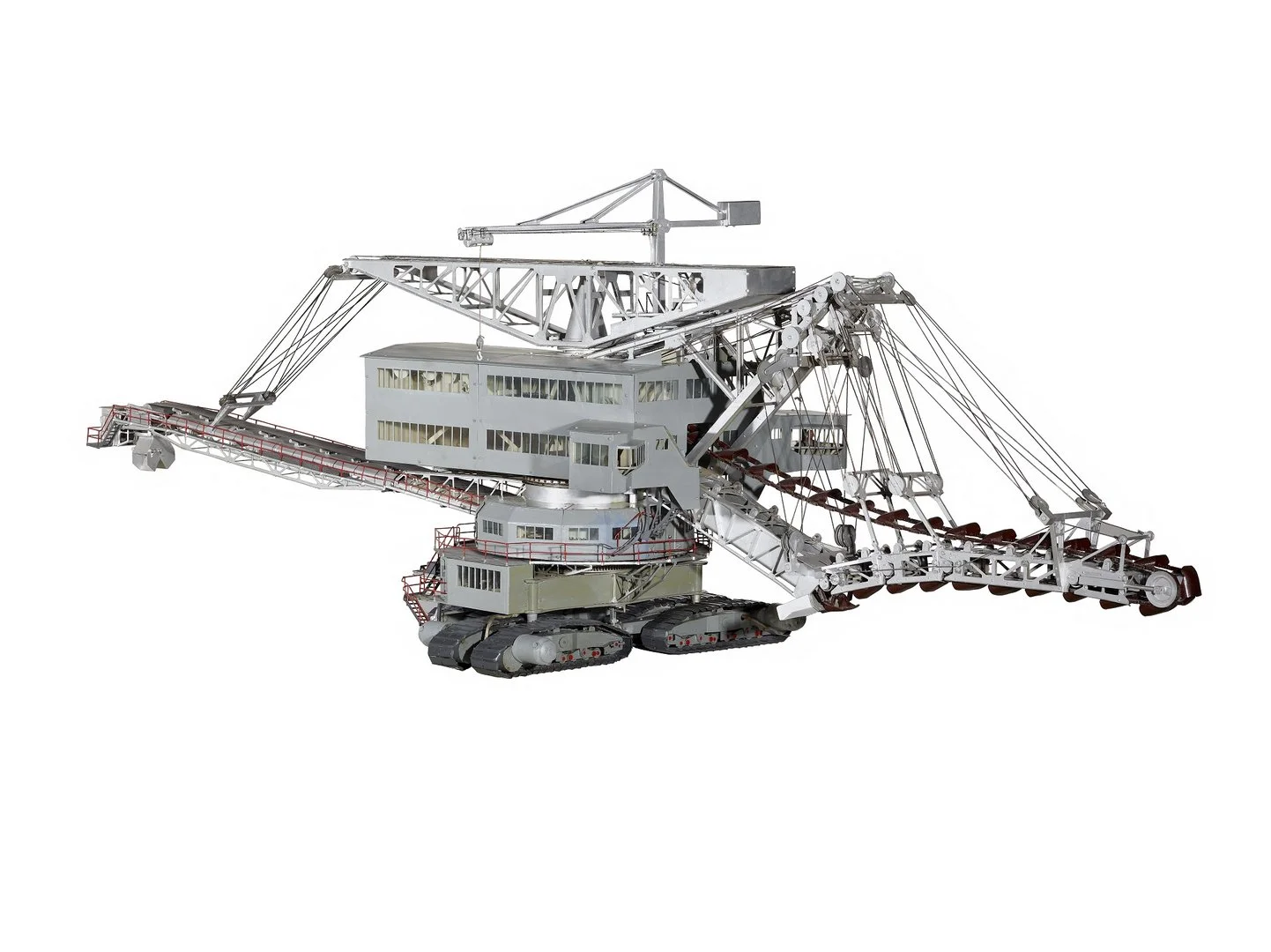
Model of the ERs 700 bucket-chain crawler swing excavator, Magdeburg, 1953/1956 © DHM
Dr. Martin Baumert is a research associate for the exhibition “Nature and German History” at the Deutsches Historisches Museum.
9 June 2026
Martin BaumertNature and German History
29 May 2026
Dorlis BlumeNature and German History

11 February 2026
Ursula HeinzelmannNature and German History
17 December 2025
Martin BaumertNature and German History

28 November 2025
Julia VossNature and German History
14 November 2025
Julia VossNature and German History