“Working with collections and researching individual objects is essentially about understanding the historical circumstances in which they were created.”
27 July 2026
Editors , Brigitte ReinekeResearch
29 May 2026 Reading duration 4 Min.
In 2024, the United Nations introduced International Potato Day to recognise the importance of the potato for food security. International Potato Day is celebrated annually on 30 May. The exhibition “Nature and German History. Faith – Biology – Power” devotes a separate chapter to the potato, since many people regard it as the “German vegetable” par excellence. But is this really the case?
“The potato, a tuber originally from the Americas, which for the past 50 to 60 years, owing to its extraordinary fertility and manifold benefits, has become almost native to us and our neighbours […].”
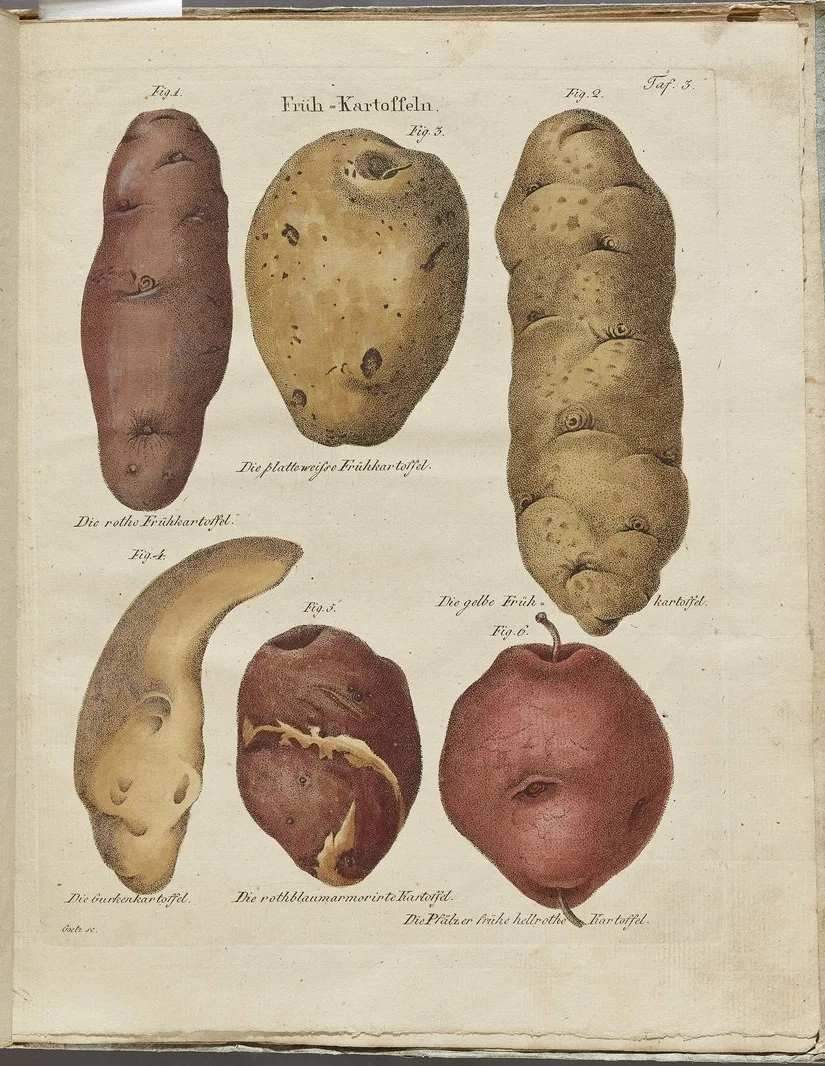
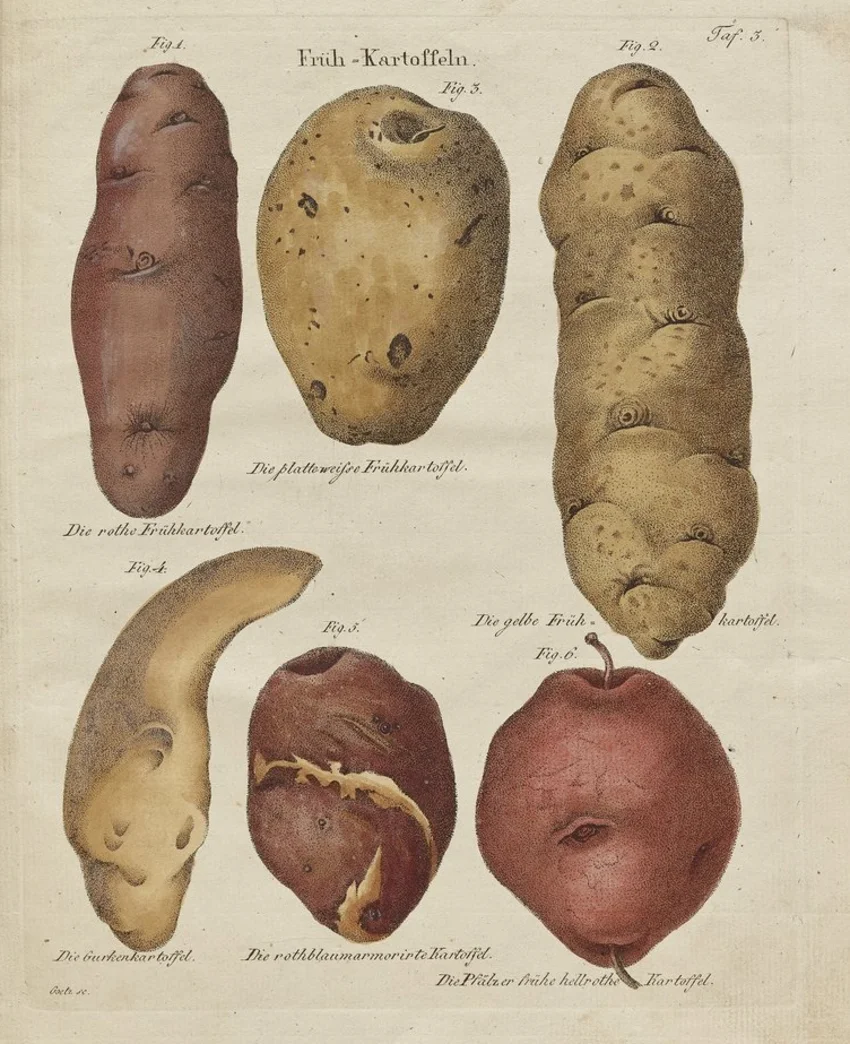
Carl Wilhelm Ernst Putsche, Versuch einer Monographie der Kartoffeln, Plate 3 Die Frühkartoffel, Weimar, 1819 © DHM
This is how the Enlightenment thinker Johann Georg Krünitz described the triumph of the potato in the 35th volume of his Oeconomische Encyclopädie, published in 1785. On a total of 180 pages, Krünitz set out all the essential aspects of the potato. In addition to its origins and spread throughout the German-speaking world and Europe, he also outlined its cultivation and diverse uses, right through to health-related aspects.
It was the conquistadors led by Francisco Pizarro who were the first Europeans to encounter the potato when they began to conquer the Inca Empire in South America starting in 1526. From the inhabitants of the highlands of Peru and Chile, they learned a drying method that preserved the potato. Thus, from 1565 on, the tubers became a popular provision on ships, and they reached the rest of Europe via the Spanish overseas port of Seville. At the end of the 18th century, the opinion spread that Sir Francis Drake had brought the potato to Europe via England in 1586.
It is not possible to determine exactly when the potato arrived in Brandenburg and Prussia. In the 18th century, however, its cultivation became one of the key concerns of the Enlightenment. Positive assessments and practical advice formed the foundation on which 19th century agricultural scientists such as Albrecht Daniel Thaer could build. His concept of “rational agriculture” included the idea of a crop rotation between cereals and potatoes. The finest contemporary expression of the tuber is found in Carl Wilhelm Ernst Putsche’s essay on potatoes Versuch einer Monografie der Kartoffeln from 1819.
Thus, the potato developed into the staple food of the 19th century and one of the most important crops in the rapidly expanding agricultural production across the whole of Germany. It was important that the potato was not cultivated in a one-sided and exclusive manner, as happened in Ireland: since the diet of the common people there consisted almost exclusively of potatoes, over a million people died following the crop failures caused by the potato blight between 1845 and 1848.
The names of the contemporary agricultural economists are largely forgotten today. By contrast, the Prussian King Friedrich II (1712–1786), known in English as Frederick the Great, is associated with the introduction of the potato like no other. This is primarily due to his so-called Potato Decrees, 15 of which have survived. He issued the first decree as early as 9 April 1746 in Pomerania to address the famine raging there: “That, to alleviate the bread shortage, citizens and farmers who have the land and means to do so should apply themselves with greater diligence to the cultivation of good garden produce, in particular potatoes.” Even before the decree was published by the Pomeranian War and Domains Chamber, he had had a cartload of seed potatoes distributed to those in need. This relief effort was initially not very successful, because people had never seen such tubers before and reacted with astonishment and rejection. They did not know what to do with them and eventually threw them to the dogs, who would not eat them either. This led the King to include more detailed instructions on their use and to provide evidence of their benefits in his later “Potato Decrees”:
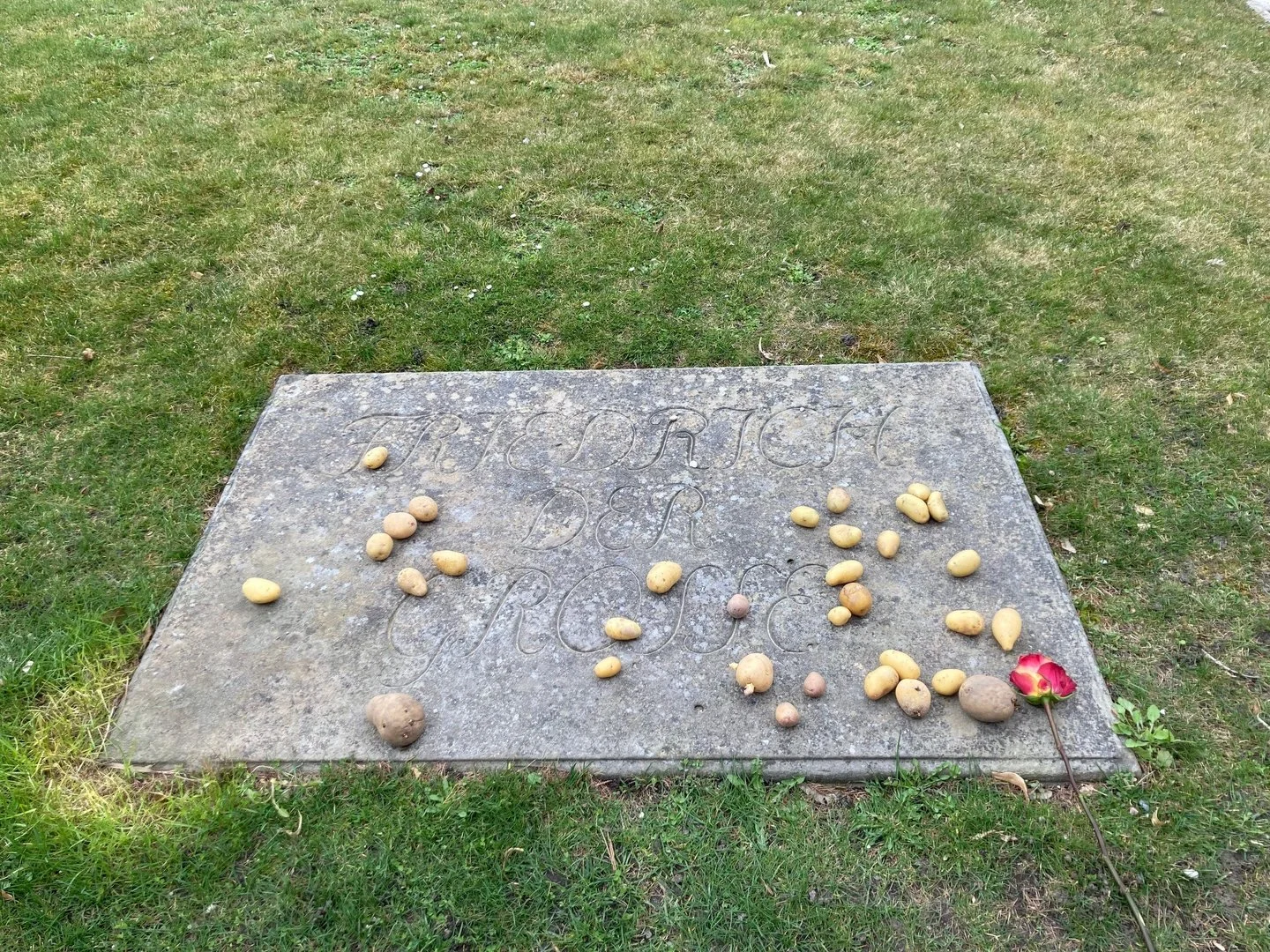
Potatoes on the tombstone of Friedrich II of Prussia, Sanssouci Park, Potsdam, 2026 © DHM, Photo: Dorlis Blume
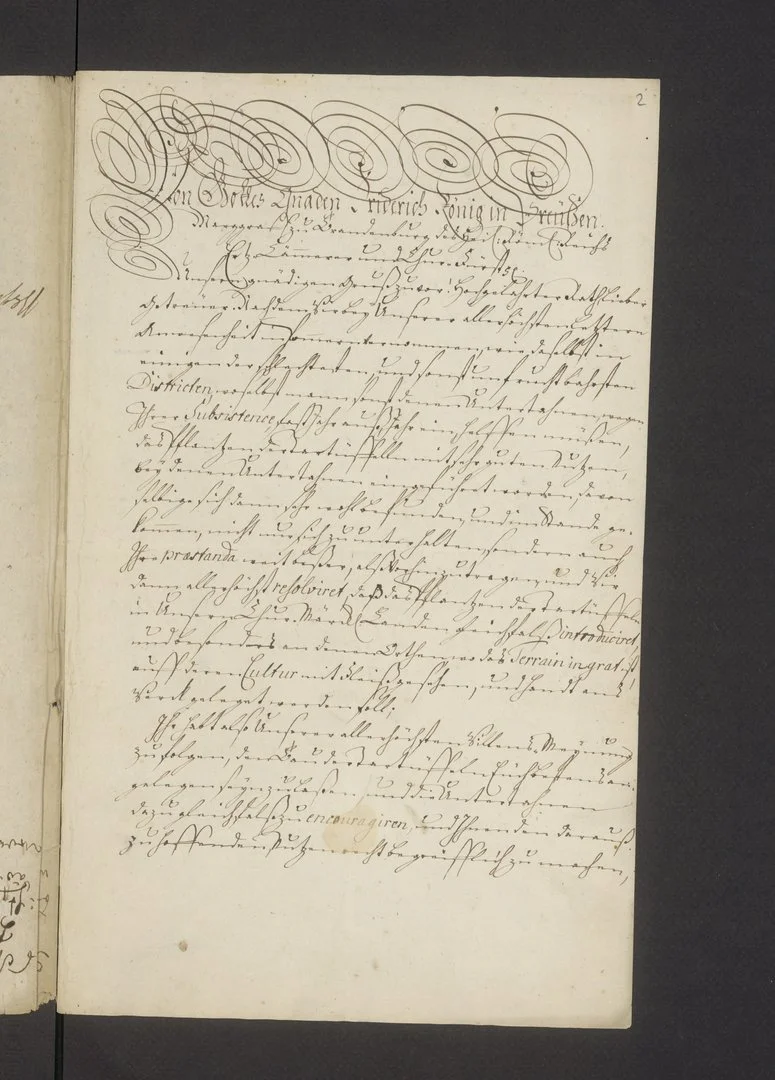
Friedrich II’s potato decree in the Kurmark and Neumark, 18 July 1748 © Brandenburg State Archives, Potsdam
“As we had seen during our last stay in Pomerania how even in some of the worst and most infertile districts, […] the planting of potatoes which had been introduced to the subjects was very useful.”
In 1886, the painter Robert Warthmüller immortalised Frederick II as the “Potato King” for all time: the painting Der König überall (The King everywhere) depicts the Prussian king harvesting potatoes against the backdrop of a Brandenburg village in the Neumark. It is not known what prompted the young painter to choose this motif – perhaps the supposed 300th anniversary of the introduction of the potato to Europe by Francis Drake or the 100th anniversary of the death of Frederick the Great. What matters is that Warthmüller’s painting was a great success from the outset. It was shown in several exhibitions, reviewed in magazines, and printed as a woodcut reproduction. Right from its first presentation at the Berlin “Jubilee Exhibition” in September 1886, it was awarded an “Honourable Mention” by the Academy of Arts.
Thus, over the centuries, the shrivelled potato from Peru became a quintessentially German vegetable, one that has become an indispensable part of the menu. It is found as a Christmas tree decoration as well as the namesake for naturalisation ceremonies, which are often referred to as “potato festivals”.
And as Krünitz concluded as early as 1785:
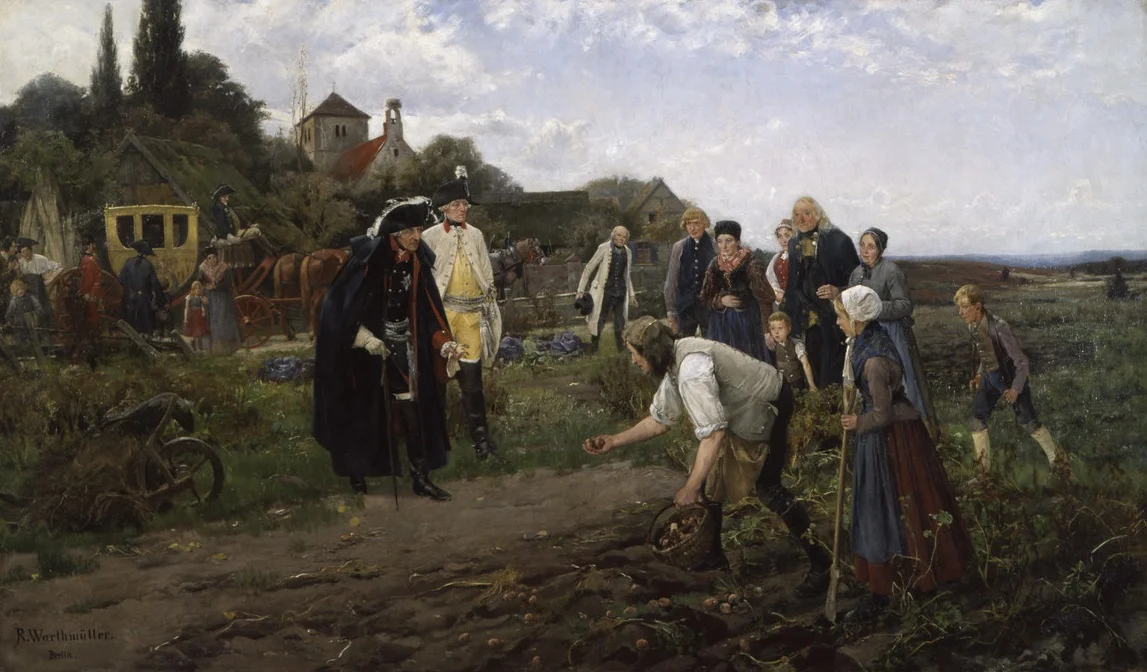
Robert Warthmüller (1859–1895), The King Everywhere, 1886 © DHM
“If one wishes to assess the value of things not by their imagined but by their actual utility in satisfying true and universal human needs, one must admit that the discovery of America, through the spread of this fruit, has become more important to posterity than the rich gold mines, which were, after all, the cause of the most remarkable political revolutions in our part of the world.”

Dorlis Blume is Director of Exhibitions at the Deutsches Historisches Museum.
27 July 2026
Editors , Brigitte ReinekeResearch
9 June 2026
Martin BaumertNature and German History
29 May 2026
Dorlis BlumeNature and German History
5 March 2026
Anna-Lena AlmstedtHistory today
11 February 2026
Ursula HeinzelmannNature and German History
17 December 2025
Martin BaumertNature and German History
28 November 2025
Julia VossNature and German History
14 November 2025
Julia VossNature and German History