Objects. History. Stories. Reviewing the Collection
From 8 May 2026 in the Deutsches Historisches Museum
An amber board game set from Königsberg made in 1607, Queen Luise’s dressing gown from 1806, the poster for the East Berlin exhibition “40 Years of the GDR”, and the bunk bed salvaged from a refugee shelter in Kassel in 2015 – the collection of the Deutsches Historisches Museum comprises around one million objects that bear witness to German history. From 8 May 2026 to 31 October 2027, the DHM will present a selection of some 200 items, some of which have never been shown before, including surprising finds and new acquisitions. The exhibition “Objects. History. Stories. Reviewing the Collection” in the Pei Building offers insights into the practice of collecting and examines the items on display in terms of their provenance and significance.
In the first part of the exhibition, Wolfgang Cortjaens, curator and Head of the Applied Arts and Graphics Collections, focuses on the DHM’s collection itself, which, over the course of its 150-year history, has become a historical witness in its own right. The exhibition tour follows five defining eras in the institution’s eventful history between 1883 and 2006. The Zeughaus, originally built as a representative armoury for the Prussian kings in the early 18th century, housed the “Hall of Fame of the Brandenburg-Prussian Army” from 1883 onwards. Its subsequent history in the 20th century includes the building’s further utilisation, initially by the Nazi regime as a military museum, and from 1952, as the central socialist history museum of the GDR, the Museum für Deutsche Geschichte (MfDG). Following reunification in 1990, the Deutsches Historisches Museum, founded three years earlier in West Berlin, took over the Zeughaus and its collections. In 2003, the post-modern exhibition hall designed by Chinese-American architect I. M. Pei supplemented the Baroque building.
This part of the exhibition displays objects and ensembles that represent the collection’s focus and the historical perspective of the respective era. Whether a jacket from a Prussian infantry uniform, a Japanese samurai armour set given to Adolf Hitler by the Imperial Military Reservists’ Association, a socialist table centrepiece presented as a state gift from North Vietnam to the GDR, or the first print of the German-language Declaration of Independence of the United States of America – exhibits have always carried political significance. The practice of collecting was never arbitrary.
History is usually understood as a sequence and change over time. But it also tells of shifts in location. The exhibition therefore views history from a particular perspective: in the second part of the exhibition, places, locations, and regions take centre stage. Selected object histories tell of contested spheres of influence, of global trade, colonisation, and the exploration of new territories, as well as of vanished places, borders, flight and exile. The tour therefore does not follow a strict chronology, but rather shows the tense changing interrelationships between the different eras.
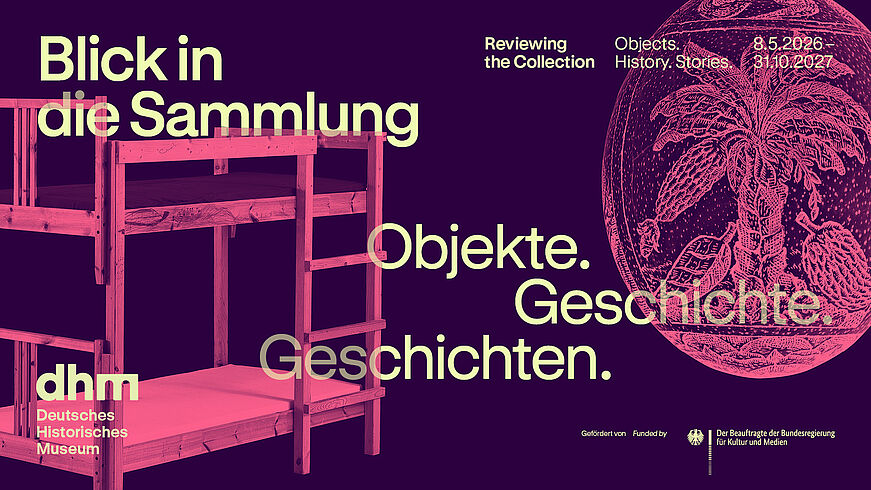
Among the collection’s displays are outstanding art cabinet pieces such as a “glass guest book” – the Counts of Oettingen’s Welcome Beaker, engraved with 30 names, dates and mottos, a unique testimony to the religious turmoil during the Reformation. A two-volume parchment Luther Bible from 1535 bears witness to the conflicts between Catholics and Protestants while also highlighting territorial claims. A precious board-game set for Nine Men’s Morris, chess and backgammon, made in 1607 for the English queen consort Anne of Denmark, illustrates the dynastic and economic interconnections in the Baltic region. An extremely rare ostrich egg, engraved with figurative scenes, tells of the struggle for supremacy in 17th-century global trade, which was closely linked to colonialism in the early modern period.
Heavy machinery and a miner’s equipment from the Prosper Haniel colliery in Bottrop – which closed its doors in 2018 as Germany’s last active coal mine – symbolise the transformation of an entire industry and a whole region. The medium of photography is represented by a collection of rare vintage prints from the early 20th century, when journeymen and journeywomen celebrated the rituals of the “Walz”, the wander years, as a subversive alternative to conformist bourgeois life.
The exhibition concludes with two object histories that could not be more contrasting, yet both tell of movements of flight as well as “migrations of objects”: on the one hand, a complete Biedermeier interior which, since its former owner’s flight during the Second World War, has undergone an eventful odyssey, only to finally return to Berlin in 2023 – just a few hundred metres from its original location –, and, on the other hand, two IKEA bed frames converted into a bunk bed that came from a refugee shelter in Kassel, established in 2015. It is adorned with children’s drawings that bear witness to their life-threatening escape by boat.
The exhibition is inclusive and largely accessible. A cartographic guidance system allows visitors to trace the origins and movements of selected objects and collections. Eyewitnesses as well as researchers from the Collections Department provide additional information in recorded interviews. Multimedia kiosks, inclusive stations, and an audio guide in German and English offer further insight during the tour. An accompanying programme explores and expands the themes throughout the exhibition’s run. In June 2026, Deutscher Kunstverlag will publish the proceedings from the conference “Playful Alliances: Amber Politics and Courtly Culture in the Early Modern Age”, which will be devoted to one of the objects on display – the amber board game set for Nine Men’s Morris, chess and backgammon.
Press tour: Wednesday, 6 May 2026, 11 am, ground floor, Pei Building
Initial high-resolution press photos are available in the press area of the DHM website.
Design: State Productions