
“Mining is not the work of one man” — Ralf Kusmierz reflects on the tradition of miners
30 September 2026
2 Min.Objects. History. Stories.
12 August 2026 7 Min.
In the winter of 1963, Renate Werwigk-Schneider, then 24 years old, attempted to escape from the GDR through an underground tunnel and was arrested by the Stasi (the East German Ministry for State Security). The young woman, a paediatrician and PhD graduate, had decided to leave the country when construction of the Wall began on 13 August 1961, 65 years ago. Her story is part of the DHM’s current exhibition “Objects. History. Stories. Reviewing the Collection”.
The exhibition presents fascinating new acquisitions and donations added to the collections of the Deutsches Historisches Museum (DHM) in recent years. Among them is a diary acquired by the Documents Collection in 2024. In it, Peter Rutzen, a university student from West Berlin, describes how, in the winter of 1963, he joined a group of “escape helpers” who were digging a tunnel beneath Bernauer Strasse to allow East Germans to cross into the West. It was through this tunnel that Renate Werwigk-Schneider – or rather, Renate Großmann, as she was then – had planned to escape. The attempt was foiled when an informer tipped off the authorities. Großmann (born in 1938) and at least 20 others were arrested and detained at the Ministry for State Security’s central remand prison in Berlin-Hohenschönhausen. In a video interview, she recalls what it was like when the Wall was built 65 years ago.
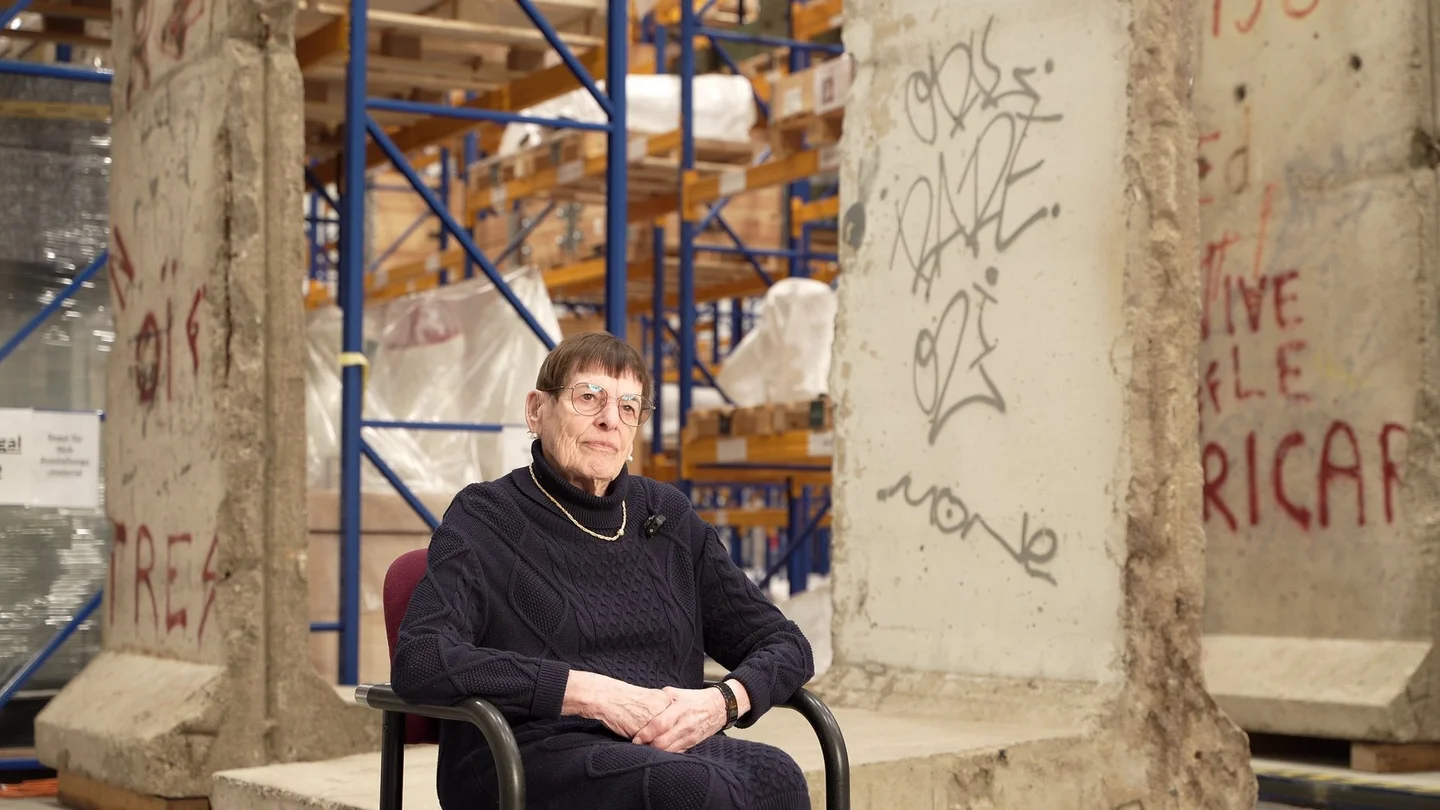
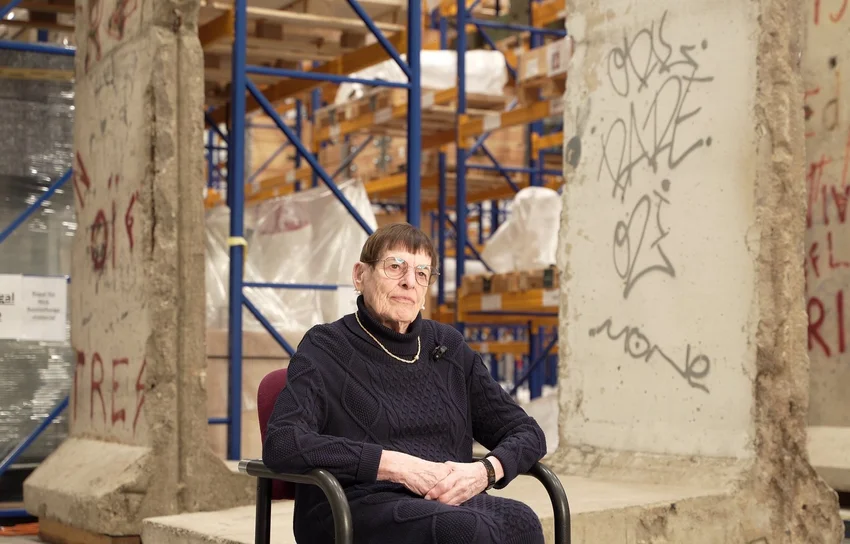
Renate Werwigk-Schneider on 11 February 2026 in a DHM storage facility, sitting in front of sections of the Berlin Wall from the 1970s. These sections were on display in the permanent exhibition “German History in Images and Artefacts” until 2021.
She got in touch with the escape helpers through her brother, who had fled to the West before her. He had actually helped dig the tunnel. Apart from people like him, who wanted to help their relatives, there were many idealists, like Peter Rutzen, the author of the diary shown in the exhibition. In it, he gives a vivid account of the difficult circumstances in which the tunnel was built, of the dangers of the work, and the fears he had. He wrote the entries shortly after finishing his shifts, providing us with an account of remarkable authenticity. For him and everyone involved, the outcome was a bitter one: an informer tipped off the authorities, and all their efforts came to nothing. In her book, Der verratene Tunnel (The Betrayed Tunnel), the former head of the Berlin Wall Memorial, Maria Nooke, reconstructs the story using records from the Stasi archives and gathers together the accounts of those involved on both sides of the Wall.
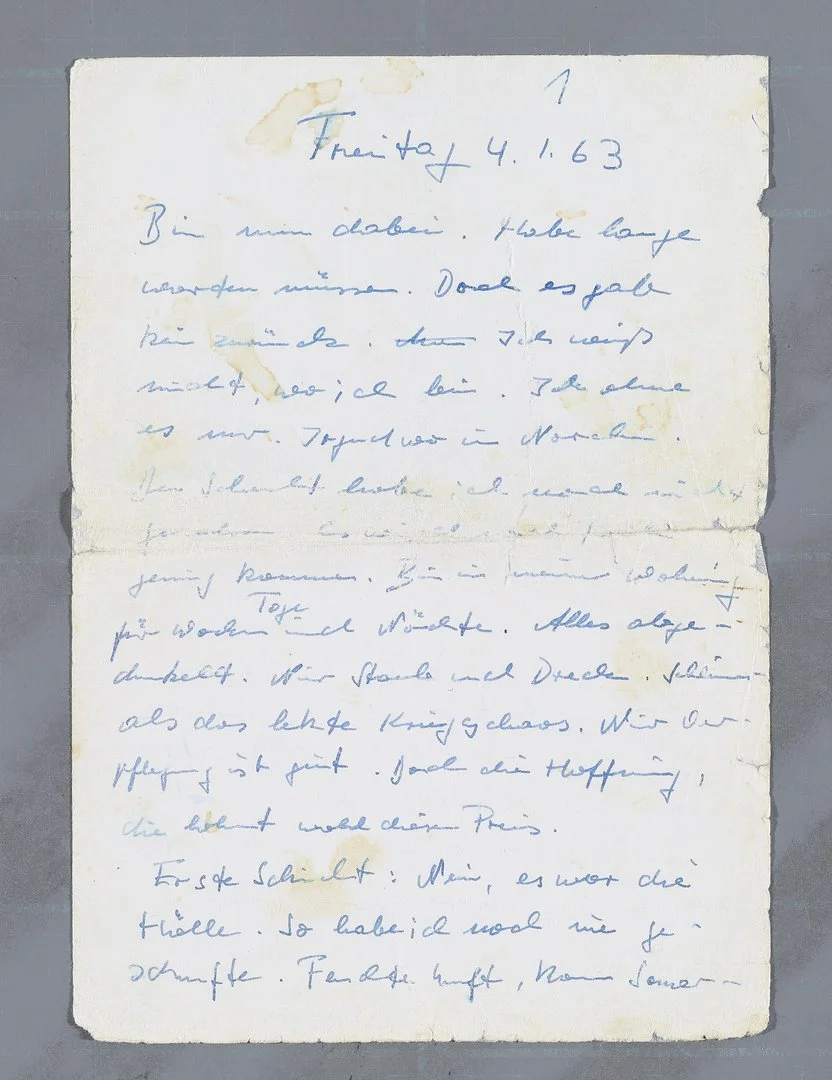
First page of Peter Rutzen’s diary. This entry, from 4 January 1963, starts out, “I’m in. Had to wait a long time. But there was no going back .”
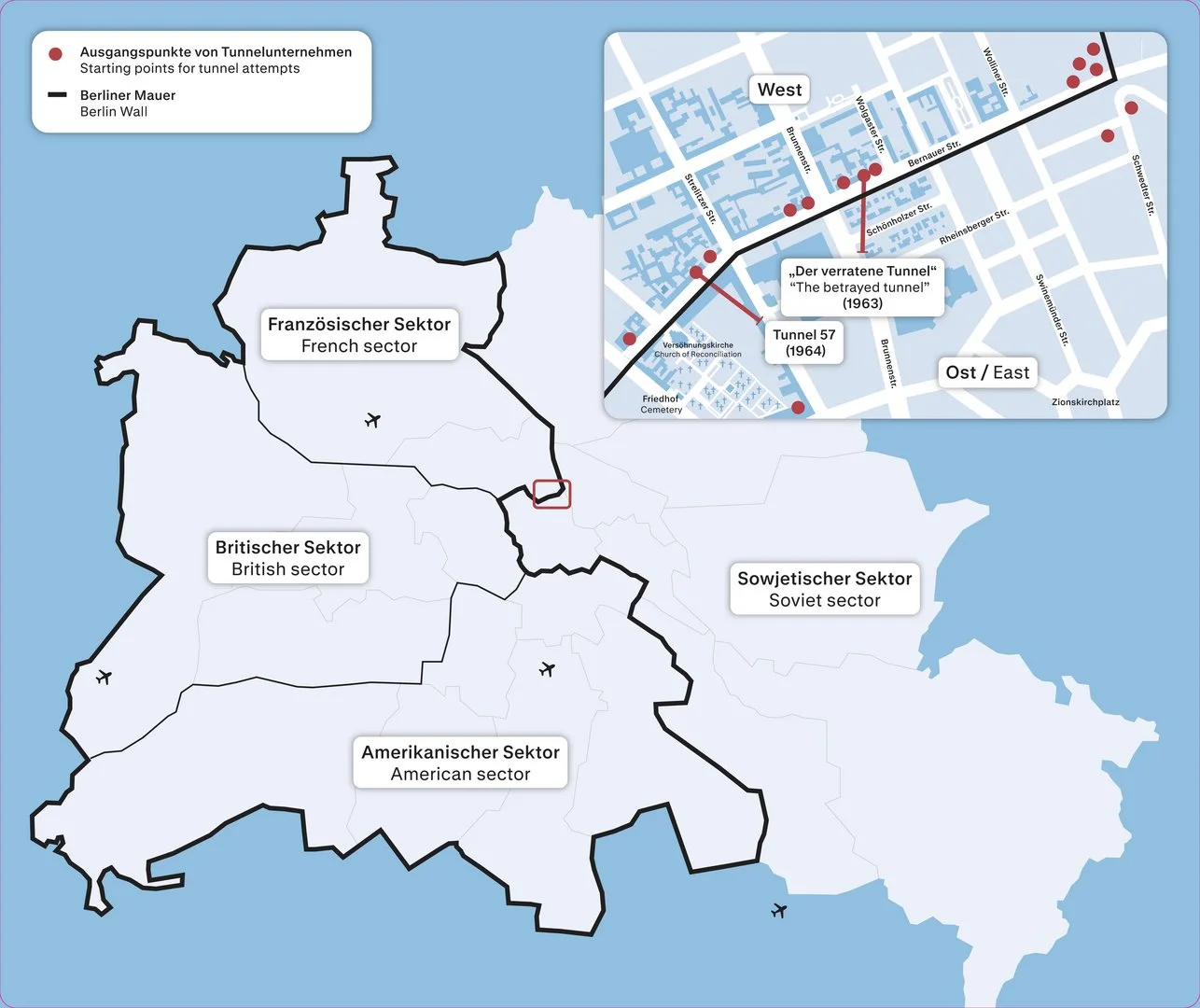
Map showing the divided city of Berlin and the borders of the four sectors. The close-up shows the area around Bernauer Strasse © Peter Palm
The first tunnels were dug just weeks after the Wall was built. In West Berlin, people wishing to help those trying to escape organised into groups, particularly around the universities. Those remembered today – Hasso Herschel, Wolfgang Fuchs, Harry Seidel – were the charismatic leaders who recruited personnel, scouted possible sites, procured equipment, and organised supplies. If the digging went undetected, a relatively large number of people could escape through the tunnels. Some became known by the number of escapees who used them: Tunnel 29, for example, or Tunnel 57, both dug under Bernauer Strasse. Fifteen tunnels have been documented in this area alone.
Renate Großmann was arrested along with her parents and held at Berlin-Hohenschönhausen while awaiting trial. After six months in solitary confinement, she was sentenced to two and a half years in prison, which she began to serve at a prison in Frankfurt an der Oder before being released as part of an amnesty in 1965. Unlike her parents, who had been broken by these experiences, she remained convinced that she did “not want to be buried in this state” and began planning her next escape. Anticipating the possibility that the attempt might not succeed and that she might be arrested again, she contacted the lawyer Wolfgang Vogel, who was known for helping to secure his clients’ release through West Germany’s prisoner-ransom programme. That second attempt was made in the summer of 1967, when she tried to cross from Bulgaria into Turkey on a forged passport. It, too, failed. Following renewed pre-trial detention at Hohenschönhausen and a period in a women’s prison, however, she was released in June 1968 as part of the prisoner-ransom programme. She is one of around 34,000 people whose freedom was secured in this way between the early 1960s and the fall of the Wall in 1989.
At least 140 people died at the Berlin Wall. Renate Werwigk-Schneider was able to practise as a paediatrician in West Berlin until she retired. Today, she shares her experiences as a witness to history and visits schools to educate pupils about the SED dictatorship. In 2025, she was awarded the German Federal Cross of Merit, First Class, for this work.
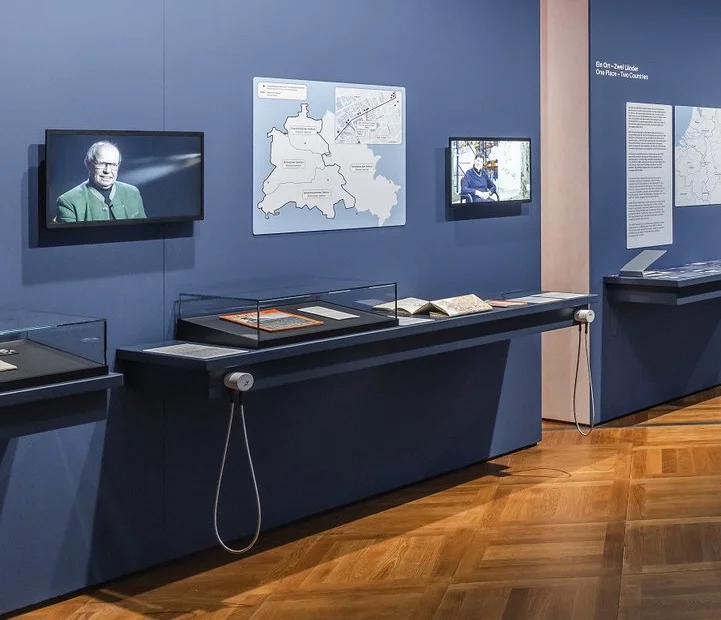
Exhibits in the section “Chronik eines Tunnelbaus” in “Objects. History. Stories. Reviewing the Collection” © DHM, David von Becker
![[Translate to English:] Portrait Martin Koch](/journal/fileadmin/_processed_/1/1/csm_Martin_Koch_01_fee0c745b3.webp)
Martin Koch is project assistant for the exhibition “Objects. History. Stories. Reviewing the Collection” at the Deutsches Historisches Museum.
30 September 2026
2 Min.Objects. History. Stories.
17 September 2026
2 Min.Objects. History. Stories.
9 September 2026
Simon SachaObjects. History. Stories.
12 August 2026
7 Min.Objects. History. Stories.
3 July 2026
Wolfgang Cortjaens , Dorlis BlumeObjects. History. Stories.
26 May 2026
Wolfgang CortjaensObjects. History. Stories.
26 May 2026
Charlotte KlonkObjects. History. Stories.
26 May 2026
Raphael GrossObjects. History. Stories.
26 May 2026
EditorsObjects. History. Stories.