“Legacies of Occupation. National Socialism and Contemporary Europe” – The Documentation Centre “German Occupation of Europe in the Second World War” (ZWBE) is organising a series of talks
Starting on 18 May 2026 at the Deutsches Historisches Museum
Eight decades after the end of the Second World War, the Documentation Centre “German Occupation of Europe in the Second World War” (ZWBE) is organising a series of discussions on the consequences and long-term impacts of the war and German occupation in Europe. Prominent guests – among them former German President Joachim Gauck, former German Ambassador to Moscow Rüdiger von Fritsch, Russian Nobel Peace Prize laureate Irina Sherbakova, journalist Michel Friedman, writer Robert Menasse, and security expert Claudia Major – will explore the legacy of occupation in the societies of the formerly occupied countries and discuss whether and how it continues to shape relations among Europeans and Europe’s collective political action today.
Hosted by Sabine Adler (Deutschlandfunk), the discussion series will take place over five evenings between May and November 2026 at the Deutsches Historisches Museum, under whose auspices the ZWBE is being established. The Centre is being founded in accordance with a resolution adopted by the German Bundestag in October 2020 in response to civil-society, academic, and political initiatives calling for full recognition of the experiences of countries across Europe that were occupied by Germany – experiences whose repercussions are still felt today. Set against the backdrop of global upheavals, the series also examines the current relevance of this project, which is central to Germany’s policies of remembrance and has been awaiting implementation for six years. The admission-free event series will be recorded and subsequently accessible on the DHM website.
All dates of the event series “Legacies of Occupation. National Socialism and Contemporary Europe”:
War, Memory, and the Present
18 May 2026, 6:30 p.m., DHM
Russia’s war of aggression against Ukraine has brought back memories of Germany’s war of annihilation against the Soviet Union. What significance does this historical experience hold for the present, and how can we counter attempts to instrumentalise it?
Opening remarks by Raphael Gross, President of the Stiftung Deutsches Historisches Museum
With Joachim Gauck and Rüdiger von Fritsch
Disparate Memories?
27 May 2026, 6:30 p.m., DHM
Germany views itself as a pluralistic society at the heart of Europe. But how are differing experiences of Nazi crimes addressed in practice? And how can conversation succeed in bridging these differences?
With Güner Yasemin Balcı, Michel Friedman, and Dotschy Reinhardt
Personal Histories and Violence
24 June 2026, 6:30 p.m., DHM
Life stories offer a complex perspective on violence that is often lost in neatly encapsulated historical narratives. How do these experiences affect us over time, in family memory? And what happens when different experiences of violence overlap?
With Helena Janeczek and Irina Scherbakova
Erosion of the Postwar Order
28 October 2026, 6:30 p.m., DHM
The international order established after 1945 has become increasingly fragile. Are the lessons of the Second World War now obsolete? How might they still offer guidance in the crises we face today?
With Ivan Krastev, Claudia Major, and Robert Menasse
Unpaid Debts?
25 November 2026, 6:30 p.m., DHM
The German occupiers subjected the countries they invaded to systematic exploitation and violence – looting, destruction, forced labour, and murder – leaving deep wounds that persisted long after the war. How did this shape Europe’s long-term economic development? How are presentday claims for reparations and restitution being debated?
With Isabel Heinemann, Elisabeth Steiner, and Bartosz T. Wieliński
All talks in this series will be held in German, partly with simultaneous interpretation. Admission is free of charge. Please register for all events at www.dhm.de/legacies-of-occupation; recordings of the event series will also be available there afterwards.
Documentation Centre “German Occupation of Europe in the Second World War”
Between 1939 and 1945, more than 230 million people lived under German occupation across what are now over 30 countries. The suffering caused by the occupation remains embedded in the collective memory of these countries to this day, while in Germany awareness of it is far more limited and fragmentary.
Against this backdrop, the ZWBE is attempting, for the first time, to convey the pan-European dimension of the German occupation while honouring the memory of the victims and strengthening the foundations for mutual understanding and collective action in Europe. The ZWBE grew out of an initiative of the German Bundestag, which approved the DHM’s implementation proposal in 2023.
For more information about ZWBE, visit www.dhm.de/zwbe.
For media inquiries, please contact Katja Tichomirova, +493020304454, tichomirova@dhm.de
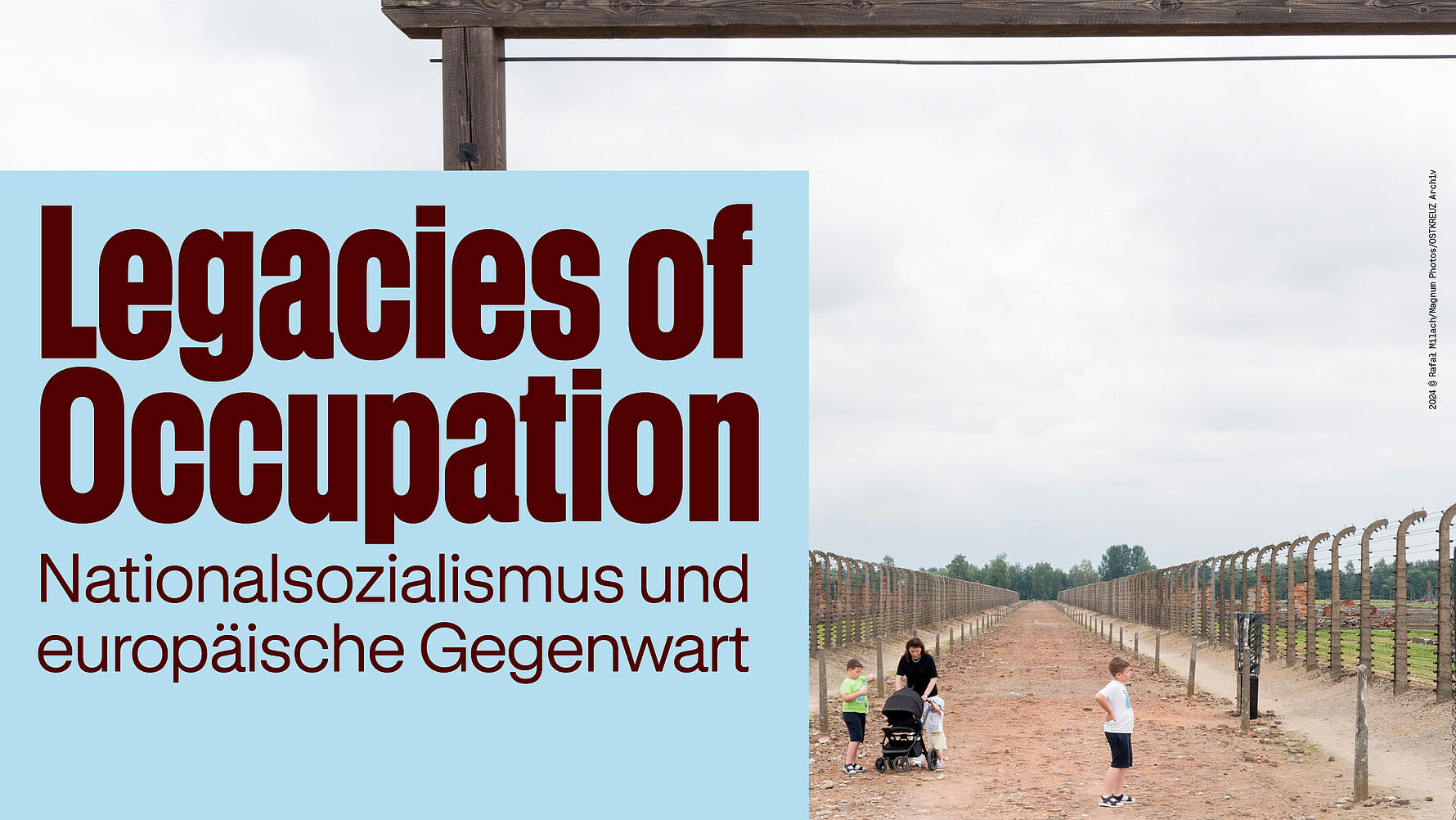
Grafik State Productions GmbH, Abbildung: Gelände des ehemaligen deutschen Vernichtungslagers, das heute Teil des Staatlichen Museums Auschwitz-Birkenau ist. Oświęcim/Polen, 7. Juli 2024 © Rafał Milach/Magnum Photos/OSTKREUZ A