Portraits of German History [WT]
From 7 April 2028 in the Deutsches Historisches Museum
Curated by Christopher Clark and Julia Voss
On 7 April 2028, the exhibition “Portraits of German History” (working title) will open in the Pei Building of the Deutsches Historisches Museum, covering a surface area of 560 square metres. Curated by Christopher Clark (curator) and Julia Voss (co-curator), the exhibition will focus on outstanding portraits of historical figures, featuring above all works that possess great intrinsic value and have an emblematic impact. Both the subjects depicted and the formats will be as diverse as possible. Princes, statesmen and stateswomen, key figures from industry, business, science, sport, culture, etc. will be represented, but also lesser known individuals, if compelling portraits of them have been preserved. An encounter with these portraits will open doors to history, reflecting the diversity of people living and working in Germany in past and present, individuals across the political spectrum from right to left, victims, perpetrators, displaced persons and expatriates, farmers, academics, refugees and immigrants, Protestants, Jews and Catholics, homosexuals, etc.
The portraits in the DHM’s extensive collections form the foundation: the museum’s own holdings offer numerous outstanding portraits in their great diversity, drawn from the museum’s long history of collecting and now on display in their opulence for the first time. Moreover, the exhibition will be expanded and complemented by works from other collections and museums. The principle of diversity also applies to formats and media. A variety of genres will be brought together, ranging from video installations and caricatures, holograms, photographs, drawings, medals, coins, banknotes and stamps, and on to oil paintings, busts and statues. The exhibition aims to foster a deeper awareness of the significance of the people living in Germany who, under diverse circumstances and in all manner of roles, have shaped German history in both grand and intimate ways.
Raphael Gross, President of the Stiftung Deutsches Historisches Museum: “The DHM has a very impressive and extensive collection of portraits. These are now to form the centrepiece of a temporary exhibition. It is an extremely challenging and exciting task, for historical paintings naturally show, above all, how people wanted to see history, and not necessarily how it actually was or looked. And this brings us straight to the heart of intriguing questions regarding the evaluation, classification and presentation of German history in portraits. How, for instance, do we deal with heroic portrayals of rulers? How do we strike a balance so that we can avoid telling history solely from the top down? How do we deal with the Nazi era? The DHM is taking on the challenge of presenting a new perspective on German history through the medium of portraits of German history.”
Wolfram Weimer, Federal Government Commissioner for Culture and the Media: “German history was shaped by people who influenced politics, the economy and society in complex ways. This portrait gallery aims to demonstrate that the long lines of our history are inextricably linked to the actions of people whose legacy is reflected in the diversity, the facets, and also the contradictions of our history. I hope this fascinating project will provide important impetus for historical awareness and a vibrant culture of remembrance.”
Christopher Clark, curator of the exhibition: “From a British perspective, it is striking that there has not previously been a project in Germany like the one at the National Portrait Gallery in London. Anyone who considers German history understands why. That is one of the challenges of this exhibition. Portraits are multifaceted records: they enable us to encounter people; they belong to history and, at the same time, to art. This intersection of different functions makes them particularly fascinating.”
Julia Voss, co-curator of the exhibition: “History is an edifice with many entrances. In this respect, portraits are unique door-openers. The particular appeal of this exhibition lies in revealing as diverse and surprising an array of approaches to German history as possible: with many people for many people.”
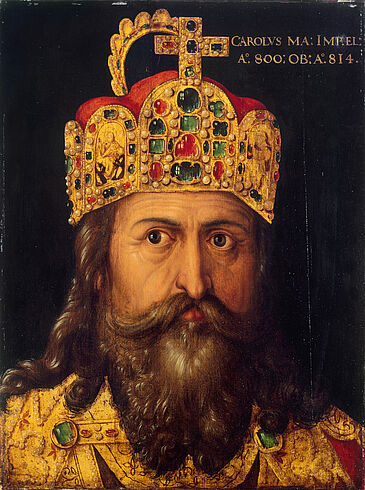
Albrecht Dürer: Ideal portrait of Charlemagne (800-814), Nuremberg, 1514, Oil, lime wood
© Deutsches Historisches Museum