DHM Receives Funding for Educational Project on Crimes Committed by German Occupiers in Europe during the Second World War
In its educational project "Reverse Shot: Images of German Crimes in Europe", the Deutsches Historisches Museum will work with young adults to develop a digital web application exploring photographs of German crimes during the Second World War. The bilingual German-English application will be developed over a period of nearly two years and will offer a transnational perspective on German occupation rule. It highlights the fact that Nazi crimes were committed across large parts of Europe.
Photographs taken by perpetrators continue to shape perceptions of German crimes committed during the Second World War. At the same time, artificial intelligence and digital image manipulation are fundamentally changing how such photographic sources are used and understood. Against this backdrop, the web application offers a critical analysis of photographs taken during the German occupation and sets them against the perspectives of the victims.
Raphael Gross, president of the Stiftung Deutsches Historisches Museum: “To this day, the memory of Nazi crimes in Europe is strongly shaped by photographs taken by the perpetrators. With ‘Reverse Shot’, we want to turn that gaze around and reveal what the images leave out. We will be looking at German occupation from a European perspective and bringing visibility to experiences that are often absent from the visual record. In the face of today’s digital challenges, the ability to read historical photographs critically is becoming an essential part of the visual literacy skill set needed for democracy.”
The project is being carried out by the DHM and the Documentation Centre "German Occupation of Europe in the Second World War" (ZWBE). It draws on the museum’s collection of photographs by Gerhard Gronefeld, who worked as a photographer for a Wehrmacht propaganda unit. Using selected examples from Western and Eastern Europe, the project will explore key aspects of German occupation, including everyday life under occupation, forced labour, “anti-partisan operations”, and, ultimately, the war of annihilation and genocide. The web application is intended to help users interpret such images critically, consider the circumstances in which they were produced, and identify gaps in the visual record. The application will be developed collaboratively, with secondary school and university students contributing to its design and evaluation through a series of workshops and case studies. The DHM is working in partnership with the Department of History at Leipzig University, where Raphael Gross will teach a seminar that runs alongside the project.
The project is funded by the German Federal Ministry of Finance (BMF) and is implemented by the Foundation Remembrance, Responsibility and Future (EVZ) as part of its Education Agenda NS-Injustice.
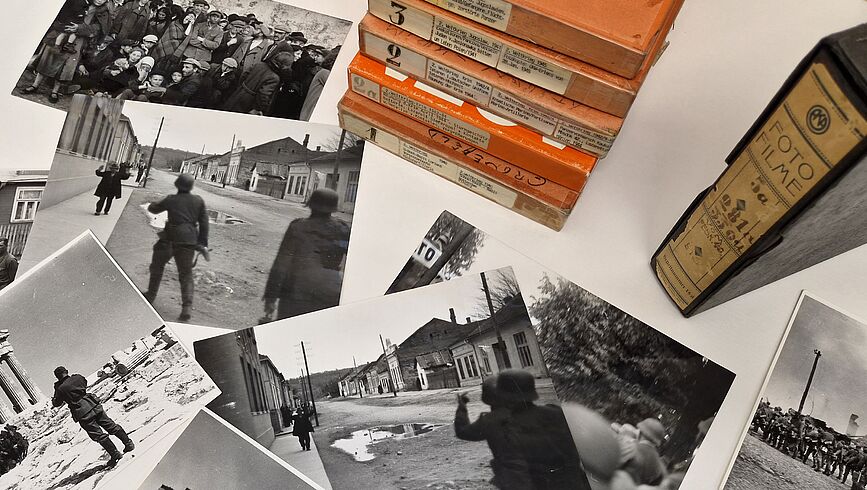
From the DHM Photography Collection: Photographs by Gerhard Gronefeld, who served as a Wehrmacht propaganda photographer in German-occupied Europe
© DHM