About us
Overview of the collections
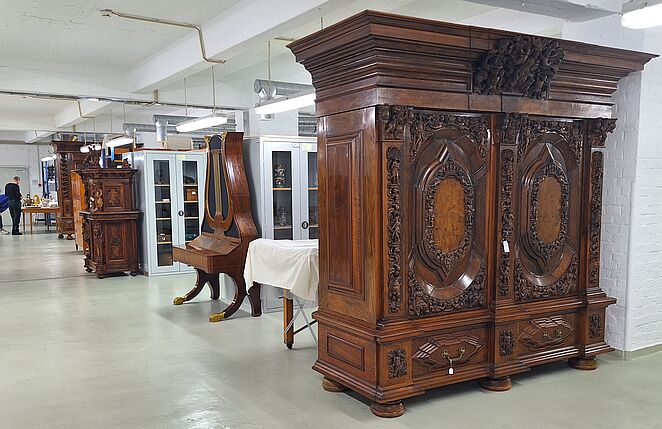
The museum’s (pre)history and that of its collections began in 1883 with the opening of the Prussian Hall of Fame in the Zeughaus. Until the end of the Second World War, the only focal points for the development of the collections at the Zeughaus Museum were war and the military. Starting in 1952, the Museum für Deutsche Geschichte (MfDG) of the German Democratic Republic (GDR), located in East Berlin, pursued a new collection strategy based on the ideology of the East German state: the aim was to seek out “material evidence” to provide historical support for the SED’s claim to power and for the socialist social order, based on a Marxist-Leninist view of history.
In the mid-1980s, Federal Chancellor Helmut Kohl initiated the founding of the Deutsches Historisches Museum, to consist primarily of a large Permanent Exhibition in Berlin. Starting in 1986, the staff, then located in Charlottenburg, began provisionally acquiring historical objects for this projected exhibition. The end of the GDR and division of Germany altered the structure of the DHM: originally planned without a collection, it now received properties and exponents from the now defunct Museum für Deutsche Geschichte and, with them, an opulent collection of approximately 500,000 objects.
The developmental phases outlined above are still evident today in the structures of our collections. While the collections of weapons and military equipment (Militaria I), personal effects and decorations (Militaria II), Manuscripts and Early Printed Books, and the library still bear traces of their origins in the Prussian Zeughaus, the document collection and the everyday culture collections are strongly influenced by the former GDR holdings.
Today, the museum’s holdings are divided into thirteen independent collections. The Collections department also has three additional sections which structure, examine and preserve the practical workflows, the “biographies” of our museum objects, and the history of the institution: the Central Documentation section, the Provenance Research section, and the In-house Archive. The overall focus and responsibilities of the DHM’s Collections department, as well as those of the individual collections, are summarised in a collection concept which can be viewed here.