Controversial Kinship. Colonial and National Socialist Violence

Press Kit
Gäbrä Mädḫən Nəguse, The Battle of Tembien, 1950s/1960s © MITAG - Museo Storico Italiano della Guerra, Rovereto
This painting, in the style of Ethiopian folk art, commemorates the first Battle of Tembien in January 1936, when Ethiopian forces fought against advancing Italian troops in northern Ethiopia.
Alfredo Gauro Ambrosi, Bombardamento in Africa Orientale (Bombardment in East Africa), Trentino 1936 © Museo dell’aeronautica Gianni Caproni (Fondazione Museo storico del Trentino, C00222
Alfredo Gauro Ambrosi painted the bombardment during the Italo-Abyssinian War of 1935–1936 in the style of aeropittura (aerial painting), thus combining enthusiasm for technology with the Italian fascists’ claims to power and superiority.
C. L. R. James during a rally at Trafalgar Square, London, 25. August 1935, Reproduktion © Keystone-France/Gamma-Keystone via Getty Images, K025939-A4
In August 1935, the Caribbean intellectual C. L. R. James (1901–1989), chairman of the International African Friends of Abyssinia, spoke to a crowd of around 500 people and warned of the impending Italian attack on Abyssinia.
Concentration camp for Herero and Nama in German South West Africa, 1905–1908 © Sam Cohen Library, Scientific Society Swakopmund (https://sciswk.com)
From 1884 to 1915, the German Empire was a colonial power in what is now Namibia. The German administration used violence to enforce its rule and repeatedly oppressed the local population, which put up resistance against land seizures and human rights violations. Between 1904 and 1908, the violence escalated in a war of extermination against the Herero and Nama. Under the command of General Lothar von Trotha, tens of thousands were killed, died of thirst in the Omaheke Desert, or perished in camps. This oppression is regarded as the first genocide of the 20th century.
High boots belonging to a member of the General SS, Obersturmbannführer, Sturm 112, 1933-1935 © Deutsches Historisches Museum
The black, knee-high boots were a defining feature of members of the SA and SS. They symbolise determination and obedience, but also violence and the suppression of opponents.
Vladimír Matějka, “Obedience“, from the nine-part cycle “There is a path to freedom …”, Příbram, after 1945 © Gedenkstätte und Museum Sachsenhausen, Oranienburg, IV 208
In 1939, Heinrich Himmler (1900–1945) coined the cynical motto: “[...] there is a path to freedom. Its milestones are obedience, diligence, honesty, order, cleanliness, sobriety, truthfulness, a spirit of sacrifice, and love of the Fatherland!” He promised that prisoners would be released from the concentration camp. In reality, this became increasingly rare after the war began. After his imprisonment, Vladimír Matějka, a former prisoner of the Sachsenhausen and Dachau concentration camps, created a nine-part cycle on Himmler’s propaganda lie, at the request of fellow prisoners. He set it against scenes of a prisoner’s everyday life at Sachsenhausen concentration camp.
Torah finials with fire damage © Jüdisches Museum Wien, Inv. Nr. 7556, photo: Lukas Pichelmann
The Torah finials come from the Währing Synagogue, which was located on Schopenhauerstrasse in Vienna. The systematic discrimination against Jewish men and women in the German Reich reached its first peak around 9 November 1938. As part of the November pogroms, anti-Semitic acts of violence took place in numerous towns and cities. The synagogue was set on fire around midday on 10 November 1938. The fire brigade intervened only to protect the surrounding houses. The building burned to the ground, and the ruins were cleared away in 1939–1940.
Miniature model of the entrance gate of the “Abyssinian Village”, Dresden, ca. 1910 © Deutsches Hygiene-Museum, Dresden
The model was created as part of a competition for the exhibition architecture of the “International Hygiene Exhibition” in 1911. The winners recreated an Abyssinian village in which around 75 men, women and children from Abyssinia were put on display. The people, brought to Germany by Continental Enterprises Limited, were forced to perform dances, re-enact combat scenes, and demonstrate their craft skills.
Measuring compass from the Dachau concentration camp, Germany © Deutsches Historisches Museum, Berlin
The measuring device was found at the camp infirmary following the liberation of Dachau. It had previously been used to measure sick prisoners.
Tropical helmet for “Schutztruppen” officials, London, 1888–1914 © Deutsches Historisches Museum, Berlin
The tropical helmet served not only as protection from the sun and rain, but it also signified affiliation with the white colonial ruling class.
Hippopotamus hoof from East Africa, mounted as a cigar case, “Max Erler” Fur Company, Leipzig, ca. 1915 © Museum der Stadt Lünen, L 074
The colonial official Ernst Goormann (1883–1964) had the hoof of a hippopotamus he had shot mounted as a cigar case. Hunting was a popular pastime and an expression of power over the colony and its natural environment. Noch ausführlicher: Colonial official Ernst Goormann had this hippopotamus hoof prepared as a “cigar case” in Leipzig by the court purveyor Max Erler. According to an invoice dated 18 June 1915, the three other hooves from the hippo that had been shot during a big-game hunt in East Africa were made into two flowerpots and a wine cooler. The hippopotamus hooves were shipped to Germany as cargo. The entire process cost Ernst Goormann – or rather, his father – 135.50 marks.
Hippopotamus hoof from East Africa, mounted as a cigar case, “Max Erler” Fur Company, Leipzig, ca. 1915 © Museum der Stadt Lünen, L 074
The colonial official Ernst Goormann (1883–1964) had the hoof of a hippopotamus he had shot mounted as a cigar case. Hunting was a popular pastime and an expression of power over the colony and its natural environment. Noch ausführlicher: Colonial official Ernst Goormann had this hippopotamus hoof prepared as a “cigar case” in Leipzig by the court purveyor Max Erler. According to an invoice dated 18 June 1915, the three other hooves from the hippo that had been shot during a big-game hunt in East Africa were made into two flowerpots and a wine cooler. The hippopotamus hooves were shipped to Germany as cargo. The entire process cost Ernst Goormann – or rather, his father – 135.50 marks.
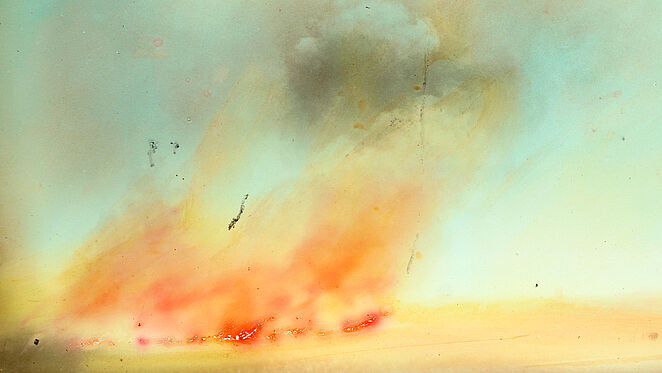
Clearing of land by setting grass on fire during a German research expedition to Tendaguru in German East Africa, 1909–1913, Photographer: Edwin Hennig or Werner Janensch © Berlin, Museum für Naturkunde, K 002, 414
Members of an expedition to excavate and remove dinosaur skeletons observed the slash-and-burn practices in East Africa. Later, expedition leader Edwin Hennig recommended this method as an efficient means of developing and controlling the natural environment in the colonies.
Shooting practice at the Colonial Women’s School Rendsburg, from a photo album of Principal Karl Körner (1885–1976), 1930s © Schleswig-Holsteinische Landesbibliothek, Kiel
Although Germany had forfeited its colonies in 1919, the colonial school took up operations eight years later. It prepared young women for life in Africa and later for settlement in the occupied eastern territories.
Franciszek Targosz and Czesław Lenczowski, „Fox Hunting“, Auschwitz concentration camp 1943–1944 © Państwowe Muzeum Auschwitz-Birkenau, Oświęcim
Rudolf Höss (1900–1947), commandant of Auschwitz concentration camp, commissioned two concentration camp prisoners to paint this picture: Franciszek Targosz (1899–1979) began the painting and Czesław Lenczowski (1905–1984) completed it. It reflects the Höss family’s aristocratic lifestyle, which was also evident in the regular hunting excursions near the camp with his son Klaus.
Aerial view of the destroyed city of Wieluń, September 1939 © Muzeum Ziemi Wieluńskiej, Wieluń
Wieluń was the first undefended Polish town to be bombed by the German Luftwaffe at the start of the war on 1 September 1939. Within a very short time, around 75 percent of the town was destroyed, including the 13th-century church. Around 1,200 people were killed. As Wieluń was not a strategic target, the attack was primarily intended to test the German dive bombers under actual combat conditions.
Production of new signs with German street names, Poznań, 1939 © Bundesarchiv, Bild 183-E11777
****The preview image shown is not approved for use. For rights clearance and a high-resolution image file, please contact: bild@bundesarchiv.de**** The Germanisation of the occupied territories began soon after the outbreak of war. It included the renaming of Polish streets, which aimed to instil a sense of belonging to the Reich among the German inhabitants. At the same time, the new German order of domination was to be made unmistakably clear to the Polish population.
Postcard featuring “Askaris” and the German Imperial flag, c. 1910 © Deutsches Historisches Museum, Berlin
African soldiers serving in the German colonial forces in German East Africa were known as “Askaris”. Due to the small number of European soldiers, the German colonial forces also began in 1889 to rely on recruits from East Africa, Sudan and Egypt.
Model 1915 “Adrian” steel helmet for the French colonial infantry, France, 1915–1918 © Deutsches Historisches Museum, Berlin
This steel helmet was introduced as the standard helmet for the French Army during the First World War. The ‘Tirailleurs sénégalais’ were also equipped with it. These units, recruited from soldiers in the French colonies in West Africa, fought as part of the French forces in both the First and Second World Wars. They were regarded as particularly formidable fighting units and were frequently deployed on risky missions such as assault operations.
Mohammed Amin al-Husseini with Heinrich Himmler, Hochwald field command post in East Prussia, 4 July 1943 © Bundesarchiv, Bild 101III-Alber-164-18A, photo: Kurt Alber
****The preview image shown is not approved for use. For rights clearance and a high-resolution image file, please contact: bild@bundesarchiv.de**** Mohammed Amin al-Husseini (ca. 1896–1974) sought to establish a pan-Arab state in the French and British mandate territories and hoped for German support. Adolf Hitler and Heinrich Himmler used him to further their own interests, to mobilise Muslim SS volunteers and disseminate anti-Semitic Nazi propaganda. Through the radio station “Radio Zeesen”, al-Husseini spread his political goals as well as Nazi ideology throughout the Arab world.
Water bottle of a Herero, 1885–1904 © Ethnologische Sammlung des Museums Natur und Mensch – Museen Freiburg, photo: Axel Killian
After the Battle of Waterberg, the Herero fled into the Omaheke Desert. The German military blocked all other routes, sealed off water sources, and prevented the men, women, and children from returning. Tens of thousands died of thirst, exhaustion, hunger, and persecution.
Frantz Fanon at an Afro-Asian solidarity conference, Conakry (Guinea), 15. April 1960 © mauritius images / TopFoto
Frantz Fanon (1925–1961), originally from Martinique, was a psychiatrist, philosopher, and writer. His analyses of colonialism, racism, and power influenced anti-colonial movements worldwide. In Algeria, he joined the Front de Libération Nationale (FLN), treated resistance fighters, and researched the psychological consequences of colonial violence and oppression. He died in the USA in 1961. Members of the Armée de libération nationale (ALN) secretly transported his body to Algeria, where Fanon was buried in accordance with his own wishes.
Jenny Wiegmann-Mucchi (1895–1969), Interrogation in Algeria, 1958/1959, Neue Nationalgalerie, Stiftung Preußischer Kulturbesitz, photo: André van Linn © VG Bild-Kunst, Bonn 2026
The German artist Jenny Wiegmann-Mucchi (1895–1969) created the bronze sculpture during the Algerian War of Independence (1954–1962). It commemorates the Algerian activist Djamila Bouhired (born 1935), who was charged by the French army with involvement in attacks, tortured, and sentenced to death. Jenny Wiegmann-Mucchi was active in the resistance against Italian fascism from 1943 to 1945.
Leaflet “Vivre libre ou mourir” (‘Live free or die’), London, 1944 © Lyon, Centre d’Histoire de la Résistance et de la Déportation, 1966.614.3
The leaflet features the French flag, the Cross of Lorraine, and Marianne. With these national symbols and the slogan from the French Revolution, it called for resistance against the German occupation.
Badges used to identify Polish forced labourers, 1939–1945 © Deutsches Historisches Museum, Berlin
From 1940, Polish forced labourers were required to wear such badges. Violations of the regulation could be penalised with imprisonment or detention in a “labour re-education” or concentration camp.
Tombstone of Esther Sulam, Rhodes, 1668 © Jewish Museum of Rhodes
Jewish life had a centuries-old tradition on Rhodes, as documented by this 17th-century tombstone. Prior to German occupation in 1943, the Jewish population numbered around 1,500. In July 1944, German forces deported the entire community to Auschwitz, including children and the elderly. The vast majority were killed in the concentration camp’s gas chambers shortly after their arrival.
Alexandro Angel, Members of the Maccabi sports club, Left to right: Buchuk Cohen, Moshe Alhadeff, Yosef Alcana, Aslan Israel, Haco Franco, Albert Alhadeff, Rahamin Benoun, Rhodos, 1938 © Rhodes Jewish Historical Foundation Archives, Los Angeles
Almost all the Jews of Rhodes were murdered in Auschwitz, including every single person pictured here. About 200 Jewish people from the island survived the Holocaust.
David Olère, “Vers la mort“ (“On the Way to Death”), Paris, 1945 © Mémorial de la Shoah, Paris (France) /Coll. David Olère, DS-O.1678
****The preview image shown is not approved for use. For rights clearance and a high-resolution image file, please contact: archives@memorialdelashoah.org**** The French artist David Olère was deported to the Auschwitz-Birkenau concentration camp in 1943 and assigned to the Sonderkommando. As a witness to the mass murder of Jewish people, he processed his experiences in numerous works of art. The painting depicts a group of people arriving at the crematorium shortly before their murder, along with its smoking chimney.
Stephan Malinowski
© Julia Baier
Graphics: © DHM/State Productions
Exhibition view "Controversial Kinship. Colonial and National Socialist Violence"
© Deutsches Historisches Museum, photo: David von Becker
Exhibition view "Controversial Kinship. Colonial and National Socialist Violence"
© Deutsches Historisches Museum, photo: David von Becker
Exhibition view "Controversial Kinship. Colonial and National Socialist Violence"
© Deutsches Historisches Museum, photo: David von Becker
Exhibition view "Controversial Kinship. Colonial and National Socialist Violence"
© Deutsches Historisches Museum, photo: David von Becker
Exhibition view "Controversial Kinship. Colonial and National Socialist Violence"
© Deutsches Historisches Museum, photo: David von Becker
Exhibition view "Controversial Kinship. Colonial and National Socialist Violence"
© Deutsches Historisches Museum, photo: David von Becker
Exhibition view "Controversial Kinship. Colonial and National Socialist Violence"
© Deutsches Historisches Museum, photo: David von Becker
Exhibition view "Controversial Kinship. Colonial and National Socialist Violence"
© Deutsches Historisches Museum, photo: David von Becker
Exhibition view "Controversial Kinship. Colonial and National Socialist Violence"
© Deutsches Historisches Museum, photo: David von Becker
Exhibition view "Controversial Kinship. Colonial and National Socialist Violence"
© Deutsches Historisches Museum, photo: David von Becker
Exhibition view "Controversial Kinship. Colonial and National Socialist Violence"
© Deutsches Historisches Museum, photo: David von Becker
Exhibition view "Controversial Kinship. Colonial and National Socialist Violence"
© Deutsches Historisches Museum, photo: David von Becker
Exhibition view "Controversial Kinship. Colonial and National Socialist Violence"
© Deutsches Historisches Museum, photo: David von Becker
Exhibition view "Controversial Kinship. Colonial and National Socialist Violence"
© Deutsches Historisches Museum, photo: David von Becker
Exhibition view "Controversial Kinship. Colonial and National Socialist Violence"
© Deutsches Historisches Museum, photo: David von Becker
Exhibition view "Controversial Kinship. Colonial and National Socialist Violence"
© Deutsches Historisches Museum, photo: David von Becker
Exhibition view "Controversial Kinship. Colonial and National Socialist Violence"
© Deutsches Historisches Museum, photo: David von Becker
Exhibition view "Controversial Kinship. Colonial and National Socialist Violence"
© Deutsches Historisches Museum, photo: David von Becker
Exhibition view "Controversial Kinship. Colonial and National Socialist Violence"
© Deutsches Historisches Museum, photo: David von Becker
Exhibition view "Controversial Kinship. Colonial and National Socialist Violence"
© Deutsches Historisches Museum, photo: David von Becker
Exhibition view "Controversial Kinship. Colonial and National Socialist Violence"
© Deutsches Historisches Museum, photo: David von Becker
Exhibition view "Controversial Kinship. Colonial and National Socialist Violence"
© Deutsches Historisches Museum, photo: David von Becker
Exhibition view "Controversial Kinship. Colonial and National Socialist Violence"
© Deutsches Historisches Museum, photo: David von Becker
Exhibition view "Controversial Kinship. Colonial and National Socialist Violence"
© Deutsches Historisches Museum, photo: David von Becker
All press materials available for download are protected by copyright law. Materials may not be altered or modified in any way and are solely intended for news reporting and editorial coverage in conjunction with DHM’s current exhibitions, programmes, and projects, as well as its departments and buildings. Images must be credited to the DHM, together with the title of the exhibition and the name of the photographer.