Controversial Kinship. Colonial and National Socialist Violence
From 16 October 2026 to 11 April 2027 at the Deutsches Historisches Museum
What do colonial and Nazi violence have in common? How do they differ? And why has the question of a possible connection between the two remained controversial to this day? Since the 1930s, questions such as these have been debated by anti-colonial thinkers, journalists, politicians, historians, and Holocaust survivors. The exhibition "Controversial Kinship: Colonial and National Socialist Violence" – curated by Stephan Malinowski and opening at the Deutsches Historisches Museum on 16 October 2026 – examines a historical comparison that has been debated for nearly a century and extends far beyond the discipline of history. As the first exhibition in the world devoted to this subject, "Controversial Kinship" traces the debate over similarities, differences, and equivalence back to its historical origins. The museum’s aim is to promote a more nuanced discussion of the topic and enable visitors to assess such comparisons for themselves on the basis of historical evidence.
1900 to 1960: History of the Comparative Debate
In the mid-1930s, intellectuals in the centres of the anti-colonial movement – from Calcutta, Algiers, and Accra to London, Paris, and New York – advanced the idea, still influential today, that two historical regimes of violence were closely related, even though they differed markedly in temporal, geographical, and structural terms: European colonial rule, which lasted for several centuries, and Nazi domination over Europe, which ended barely six years after it had begun but saw acts of violence conceived and carried out with extraordinary speed. Anti-colonial thinkers regarded fascist rule in Europe as the continuation of colonial and racist violence in a new form, now turned against Europe itself. International in scope, the exhibition recounts the history of this comparative debate from a broad geographical and temporal perspective. Focusing on the Nazi regime of violence and the Holocaust, it asks which colonial experiences served as the principal points of comparison in the debates between 1900 and 1960.
Controversial Kinship: Nine Key Themes
Colonial and Nazi rule were rooted in violence, exploitation, and annihilation. While they may appear at first glance to have numerous similarities, a closer examination also reveals fundamental differences. The question of whether the two systems of violence are related in any substantive sense remains contested. Even more controversial, both then and now, is the question of the extent and significance of the parallels between them, and whether these parallels imply continuities or even causal connections. In this context, the DHM presents an empirically grounded examination of historical phenomena whose interrelationships can be productively explored across both forms of rule, without reducing one to the other or treating them as identical.
Just after the prologue, the first of the exhibition's nine galleries examines the conditions under which anti-colonial intellectuals in the 1930s first advanced the idea of a link between colonialism and fascism. The historical backdrop is Fascist Italy's invasion of the Ethiopian Empire in October 1935 and the global protests against this exceptionally brutal colonial war of conquest.
As visitors continue through the 1,100-square-metre exhibition space, they encounter a range of themes central to colonial and National Socialist rule that have long shaped debates about the relationship between the two: repression; racism and antisemitism; conquest and settlement; concentration camps; collaboration; resistance; forced labour; industrialised extermination; and the (in)visibility of extreme violence. Historical source material is presented alongside contemporaneous and later interpretations. The exhibition also examines how comparisons between the two systems have been politically instrumentalised since the 1930s. In the epilogue, newly recorded video interviews with historians from around the world offer a variety of perspectives on the relationship between colonial and Nazi rule. The focus is on questions of continuity, rupture, and comparability.
The Limits of Historical Comparison
Historical comparisons can help us understand systems of violence, evaluate different interpretations, and identify structural similarities and fundamental differences. They can also flatten complexities, relativise past crimes, and be instrumentalised for ideological purposes. For this reason, the exhibition addresses the possibilities and limits of historical comparison. It portrays the systematic murder of European Jewry not as the culmination of colonial traditions of violence, but as the most radical departure from these traditions and as a turning point in the history of violence in Europe. Here, the examination of similarities and overlaps does not culminate in deeper understanding; it loses its explanatory power.
Located on the lower level of the Pei Building, the exhibition explores the debate over historical comparison through around 580 objects from the DHM’s collection and from museums and archives in Belgium, Denmark, France, Germany, Greece, Israel, Italy, Namibia, the Netherlands, Norway, Austria, Poland, Spain, South Africa, Switzerland, the Czech Republic, the United Kingdom, and the United States. It includes paintings, drawings, photographs, postcards, books, periodicals, documents, and historical artefacts. Film and audio stations provide additional perspectives on the exhibition’s themes, while a German- and English-language audio guide offers background information on selected objects and the exhibition itself. A richly illustrated catalogue in both German and English, featuring scholarly essays by international experts, will be published by Wallstein Verlag. An accompanying academic programme, a film series, guided tours, and educational events will further expand on the exhibition’s themes throughout its run.
Tickets: Advance ticket sales will start on 1 September 2026 at ticket.dhm.de
Video interview with curator Stephan Malinowski: DHM Journal
Press conference: Wednesday, 14 October 2026, 11 a.m., Pei Building
Press photographs: High-resolution images are available in the press section of the DHM website. Please make sure to use the accompanying captions, which provide background information on the subjects depicted.
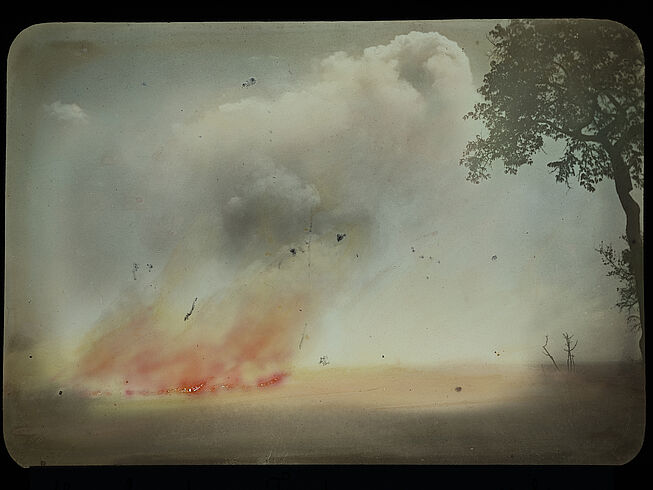
Clearing of land by setting grass on fire during a German research expedition to Tendaguru in German East Africa (now Tanzania), 1909–1913, Photographer: Edwin Hennig or Werner Janensch © Berlin, Museum für Naturkunde, K 002, 414.